



Governed financial operations for AI agents. Payment intents, approval gates, evidence, reconciliation. Agents propose — policy decides — humans approve — system executes.
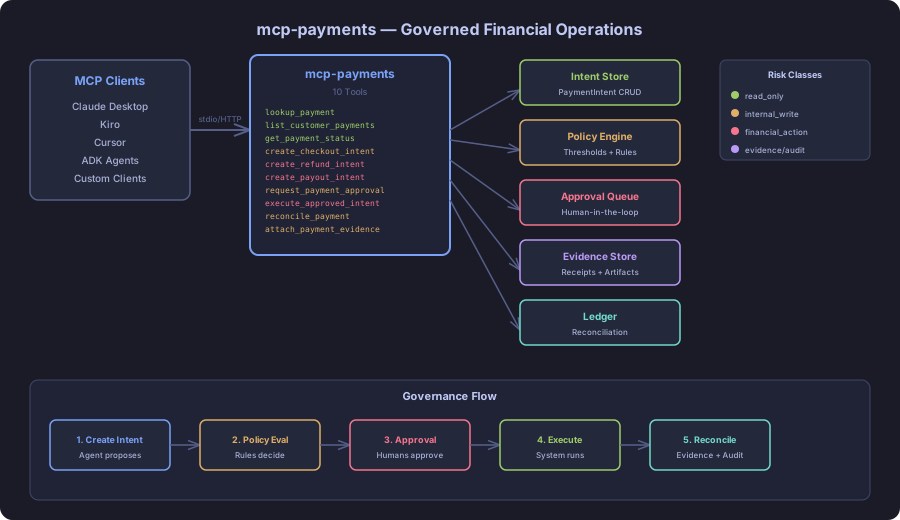
- Intent-based — agents create payment intents, never execute payments directly
- No direct execution — every financial action passes through policy evaluation and approval gates
- i64 money — all amounts in minor units (cents/pence), no floating point, no rounding errors
- No secrets — credentials stay in vault references, never in tool parameters or responses
- Idempotency — every write tool requires an
idempotency_keyto prevent duplicate operations - Audit trail — every action records
actor,reason, and timestamp for compliance
Traditional payment MCP servers expose raw API calls: charge_card(amount, token). This is dangerous for AI agents because:
- No governance — an agent hallucination can trigger a real charge
- No approval — high-value transactions execute without human review
- No audit — no record of why a payment was made or who authorized it
- No reconciliation — payments exist in isolation, disconnected from business context
mcp-payments solves this with an intent-based governance model:
- Agents express intent ("I want to charge $50 for order #123")
- Policy engine evaluates the intent against configurable rules
- High-risk intents queue for human approval
- Only approved intents can be executed
- Every payment links to evidence and reconciles against source records
The agent never touches money directly. It proposes, the system governs.
| Tool | Purpose | Risk Class |
|---|---|---|
lookup_payment |
Look up a payment intent by ID | Read-only |
list_customer_payments |
List all payments for a customer | Read-only |
get_payment_status |
Get current status and reconciliation state | Read-only |
| Tool | Purpose | Risk Class |
|---|---|---|
create_checkout_intent |
Create inbound checkout intent (Draft) | Internal write |
create_refund_intent |
Create outbound refund intent | Financial action |
create_payout_intent |
Create outbound payout intent | Financial action |
| Tool | Purpose | Risk Class |
|---|---|---|
request_payment_approval |
Submit Draft → PendingApproval | Internal write |
execute_approved_intent |
Execute only if status=Approved | Financial action |
| Tool | Purpose | Risk Class |
|---|---|---|
reconcile_payment |
Match payment against order/invoice reference | Internal write |
attach_payment_evidence |
Attach receipt, invoice, or audit artifact | Internal write |
Every financial operation enforces these controls:
- Actor identification — every write requires
actorfield identifying who/what initiated - Reason logging — every write requires
reasonexplaining business justification - Idempotency — every write requires
idempotency_keypreventing duplicate execution - Amount thresholds — checkout intents > 10,000 minor units automatically require approval
- Refund approval — all refunds require
finance_managerapproval - Payout approval — all payouts require
finance_manager+compliance_officerapproval - Execution gate —
execute_approved_intentonly works onApprovedstatus intents - Status machine — intents follow Draft → PendingApproval → Approved → Executing → Captured
- Reconciliation — payments must reconcile against source records (Matched/Discrepancy)
- Evidence chain — audit artifacts attach to intents for compliance review
pub struct PaymentIntent {
    pub id: String,
    pub direction: Direction,          // Inbound | Outbound
    pub intent_type: IntentType,       // Checkout | Refund | Payout | ...
    pub status: IntentStatus,          // Draft → PendingApproval → Approved → Captured
    pub amount: Money,
    pub counterparty: Counterparty,
    pub rail: Option<PaymentRail>,
    pub policy: Option<PolicyDecision>,
    pub approvals: Vec<Approval>,
    pub evidence: Vec<EvidenceArtifact>,
    pub reconciliation: ReconciliationStatus,
    pub reason: String,
    pub created_by: String,
    pub created_at: String,
    pub idempotency_key: String,
}

pub struct Money {
    pub amount_minor: i64,             // Always minor units (cents)
    pub currency: String,              // ISO 4217 (e.g., "usd")
}

pub struct PolicyDecision {
    pub decision: PolicyDecisionResult, // Allowed | RequiresApproval | Blocked
    pub reasons: Vec<String>,
    pub required_approvals: Vec<String>,
}

pub struct EvidenceArtifact {
    pub id: String,
    pub artifact_type: EvidenceType,   // Receipt | Invoice | OrderSnapshot | ...
    pub uri: String,                   // Reference to artifact storage
}"Charge customer cust_123 $50 for their subscription renewal"
→ create_checkout_intent(amount_minor: 5000, currency: "usd", customer_id: "cust_123", ...)
→ Policy: Allowed (under 10000 threshold)
→ Status: Draft (ready for execution)
"Process a $500 equipment purchase for customer cust_456"
→ create_checkout_intent(amount_minor: 50000, currency: "usd", ...)
→ Policy: RequiresApproval (exceeds threshold)
→ request_payment_approval(payment_id: "...", ...)
→ Status: PendingApproval (waiting for finance_manager)
"The finance manager approved payment pay_789, execute it"
→ execute_approved_intent(payment_id: "pay_789", ...)
→ Status: Captured
"Match payment pay_789 against order ORD-2025-001"
→ reconcile_payment(payment_id: "pay_789", reference_id: "ORD-2025-001", reference_amount_minor: 50000, ...)
→ Reconciliation: Matched
cargo install mcp-paymentsOr build from source:
git clone https://github.com/zavora-ai/mcp-payments
cd mcp-payments
cargo build --release{
"mcpServers": {
"payments": {
"command": "mcp-payments",
"args": [],
"env": {}
}
}
}Add to .kiro/settings/mcp.json:
{
  "mcpServers": {
    "payments": {
      "command": "mcp-payments",
      "args": [],
      "env": {}
    }
  }
}Add to .cursor/mcp.json:
{
  "mcpServers": {
    "payments": {
      "command": "mcp-payments",
      "args": [],
      "env": {}
    }
  }
}mcp-payments is designed to work within the ADK-Rust Enterprise ecosystem:
| System | Integration |
|---|---|
| ADK-Payments | Backend execution engine — mcp-payments creates intents, ADK-Payments processes them |
| Credentials Vault | Payment provider credentials stored as vault references, never in MCP context |
| Governance Policy | External policy rules feed into the Policy Engine for threshold and approval decisions |
| Artifacts Store | Evidence artifacts (receipts, invoices) stored externally, referenced by URI |
| Document | Description |
|---|---|
| API Reference | All 10 tools with parameters, types, and examples |
| Governance | Policy evaluation, approval flows, execution gates |
| Architecture | System diagram |
| CHANGELOG.md | Version history |
| mcp-server.toml | ADK-Rust Enterprise registry manifest |

[server]
name = "mcp-payments"
version = "2.0.0"
description = "Governed Payment Operations MCP"
category = "finance"
risk_level = "high"
writes_allowed = "gated"
transports = ["stdio"]
credentials = ["vault://payment-credentials"]
governance_gates = ["amount_threshold", "refund_approval", "payout_approval"]This server implements the ADK MCP SDK contract:
- HealthCheck — async health probe for registry monitoring
- mcp-server.toml — manifest declaring tools, risk classes, and credentials
- Structured tracing —
RUST_LOGenv-filter for observability
 James Karanja Maina |
|---|
Apache-2.0 — see LICENSE for details.
Part of the ADK-Rust Enterprise MCP server ecosystem.
Built with ❤️ by Zavora AI