The code in this codebase has similar functionality to Soroban's quick start contract, so I could compare contract sizes using NEAR's suggested defaults vs Soroban's.
Here's their code:
#![no_std]
use soroban_sdk::{contractimpl, symbol, vec, Env, Symbol, Vec};

pub struct Contract;

#[contractimpl]
impl Contract {
    pub fn hello(env: Env, to: Symbol) -> Vec<Symbol> {
        vec![&env, symbol!("Hello"), to]
    }
}

#[cfg(test)]
mod test {
    use super::{Contract, ContractClient};
    use soroban_sdk::{symbol, vec, BytesN, Env};

    #[test]
    fn test() {
        let env = Env::default();
        let contract_id = BytesN::from_array(&env, &[0; 32]);
        env.register_contract(&contract_id, Contract);
        let client = ContractClient::new(&env, &contract_id);

        let words = client.hello(&symbol!("Dev"));
        assert_eq!(
            words,
            vec![&env, symbol!("Hello"), symbol!("Dev"),]
        );
    }
}
Here's the code from src/lib.rs in this project:
use near_sdk::borsh::{self, BorshDeserialize, BorshSerialize};
use near_sdk::{near_bindgen, AccountId};

#[near_bindgen]
#[derive(Default, BorshDeserialize, BorshSerialize)]
pub struct Counter;

#[near_bindgen]
impl Counter {
    pub fn hello(&self, to: &AccountId) -> (String, AccountId) {
        (String::from("hello"), to.clone())
    }
}

/*
 * The rest of this file sets up unit tests
 * Run with `cargo test`
 */

// use the attribute below for unit tests
#[cfg(test)]
mod tests {
    use super::*;

    #[test]
    fn hello() {
        // instantiate a contract variable with the counter at zero
        let contract = Counter;
        let account_id: AccountId = "near".parse().unwrap();
        assert_eq!(
            ("hello".to_string(), account_id.clone()),
            contract.hello(&account_id)
        );
    }
}Soroban's contract size:

NEAR's contract size:

Soroban contracts are 3% the size!
NEAR smart contracts built with Rust are big for two main reasons:
std, the standard library, which Soroban requires you skip (see that#![no_std]?)- JSON serialization for the function arguments, which uses serde_json
I know there are ways to avoid both of these with NEAR smart contracts, but the only people I've known to attempt it are Rust experts. Soroban seems like they're trying to give all developers this superpower by default.
With just some build process changes, you can build an optimized version of your Soroban smart contract:

3.3 kilobytes wasn't small enough! Had to make it about 10x smaller yet.
Damn, y'all. Settle down.
I met someone from the Stellar Developer Relations team while at NEARCON. When I mentioned Stellar to a NEAR maxi, he said something like "Stellar's not going anywhere, though."
I mean, maybe?
Stuff I like about Stellar:
- long track record (started in 2013, before Ethereum)
- focused on safety, scalability and global financial inclusion
- have done lots of (sloppy) token giveaways and learned interesting lessons about proving unique humanity & sybil resistance
Stuff that's interesting about Soroban, their new smart contract platform:
-
uses Wasm
-
focused on Rust
-
creator of Rust on the team??
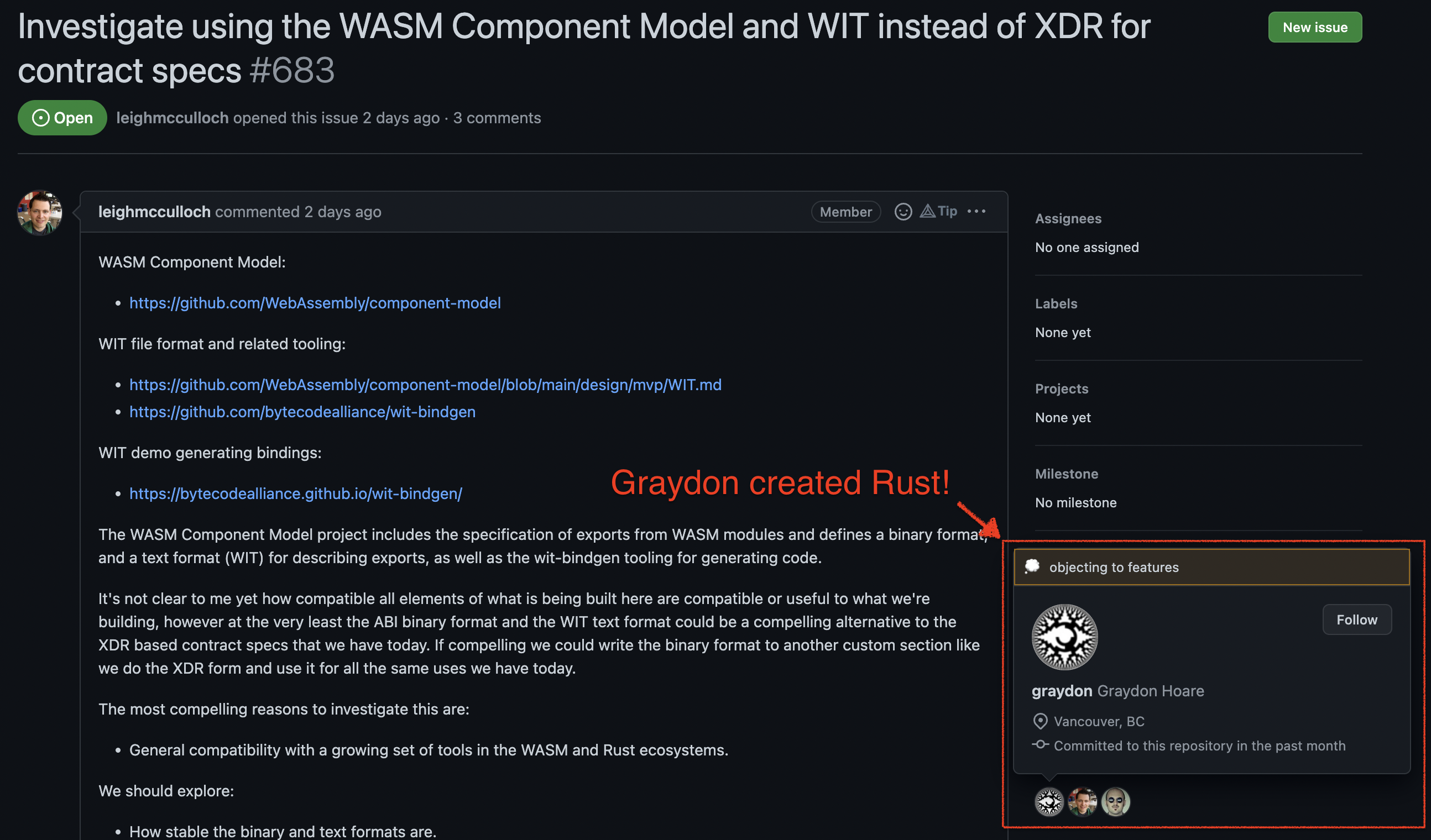
(also, yes, that's a screenshot of an issue where they're considering switching to WIT, inspired by our work!)
-
contract interface / ABI added to the Wasm custom section, RAEN-style, by default, so that Every. Single. Contract. will have fully-typed interfaces discoverable by all developers on the platform, right out the gate
-
sometimes being late to the game is an asset: can learn from existing Rust & Wasm blockchains, taking what works and tweaking what doesn't
-
those contract sizes!
So I dunno, I don't see any particular reason to dunk on them.