

Product leader with 20 years shipping 0-to-1 products. Head of Product & Experience at Distinct AI and an official n8n creator with published templates on the marketplace.
I build production-grade conversational AI, agentic RAG, and multi-agent systems for regulated industries: fintech, healthcare, and legal. My work is governance-aware by design, mapped to real compliance frameworks: SEC/FINRA, OSFI E-23, SOC 2 Type II, PCI-DSS v4.0, and OWASP LLM Top 10. Everything ships with audit trails, least-privilege tooling, and human-in-the-loop controls, built on a single principle: AI augments workflow for human judgment. It does not replace it.


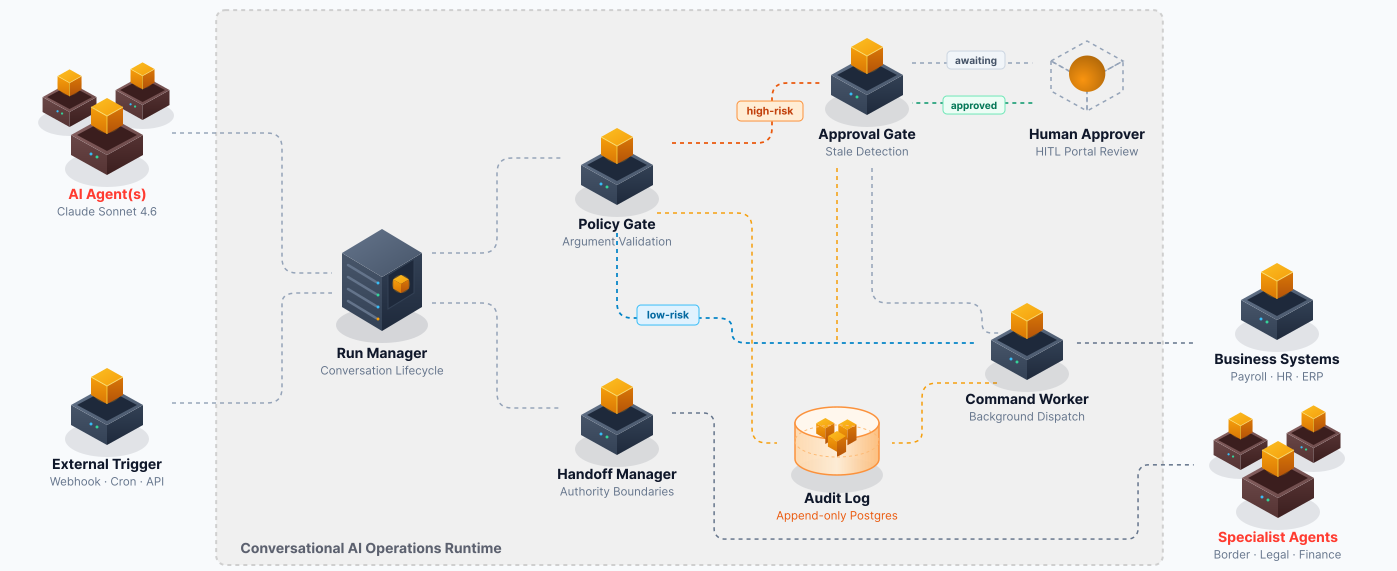
A production-grade open-source API for teams building AI agents in regulated industries. Sits between the AI model and business systems (payroll, HR, ERP), enforcing policy, routing high-risk actions to human approval, and keeping a full audit trail of every action the agent takes. Built for environments where AI cannot act without oversight. Four phases complete and tested. Apache 2.0.
| Capability | What it does |
|---|---|
| Policy gate | Evaluates tool risk level before any action is taken |
| Human approval | Routes high-risk actions to a human reviewer |
| Stale detection | Confirms nothing has changed between approval and execution; blocks the action if the situation has shifted |
| Idempotent dispatch | Prevents the same action from running twice, even if a network error triggers a retry |
| Append-only audit | Full audit trail recorded for every action; cannot be edited or deleted after the fact |
| Command worker | Executes approved actions in the background; handles partial failures and unknown outcomes without data loss |
| Managed runs | Full conversation lifecycle owned by the runtime; Claude Sonnet 4.6 as orchestrating model |
| Multi-agent handoffs | Transfers control between specialized agents with permission boundaries; each agent only sees what it needs |

A practitioner's framework for designing trustworthy conversational AI: 17 design patterns, research grounding from 46 industry and academic sources, and working prototypes demonstrating each pattern in context.
| Pattern | Core question |
|---|---|
| Proactive alerts | How does the agent surface issues before the user asks? |
| Trust calibration | How does the agent express confidence, including when it is uncertain? |
| Multi-agent handoff | How do agents transfer context without losing the user? |
| Human-in-the-loop | How does the agent require human approval before consequential actions? |
| Knowledge grounding | How does the agent answer from verified sources, not model memory? |
| Digression handling | How does the agent maintain context when the user goes off-topic mid-flow? |
| Testing and evaluation | How does the team validate agent behavior before it reaches production? |
| Conversation summarization | How does the agent capture what happened for handoffs, audit, and context reload? |
| Outcome measurement | How does the team know whether the agent actually resolved what the user needed? |
Research grounded in: Google PAIR, Microsoft HAX + Amershi et al. (CHI 2019), Anthropic, OpenAI, Nielsen Norman Group, NIST AI RMF, EU AI Act, ISO 42001, Google Conversational Agents, Jurafsky & Martin, and 15+ peer-reviewed papers from CHI, ACL, and ACM CUI.


Design patterns for products that handle sensitive content, evidence, or high-stakes investigations. Grounded in SAMHSA's six trauma-informed care principles (TIP 57) and applied to interaction design. For designers and product teams building high-stakes investigation tools, content moderation platforms, abuse reporting systems, and crisis services.
| Pattern | Category | Risk |
|---|---|---|
| Content Gating | Safety and Emotional Load | High |
| Evidence Provenance | Trust, Transparency, and Provenance | High |
| Explainable AI Output | Trust, Transparency, and Provenance | High |
| Annotation and Distance | Control, Agency, and Pacing | High |
| High-Exposure Content Review | Investigator Wellness | High |
| Neutral Microcopy | Language, Microcopy, and Inclusivity | Medium |
| Least-Privilege Access | Privacy, Security, and Ethical Safeguards | High |
13 patterns total. Includes a scorable High-Stakes UI Audit covering 8 categories and 66 items.

Design patterns for AI-assisted products that must answer for their decisions, data, and outputs. Covers 12 interlocking accountability concepts grounded in published standards, peer-reviewed research, and investigative practice. Includes established patterns with industry examples and proposed patterns that extend the existing literature where the field is thin.
| Concept | Core question | Patterns |
|---|---|---|
| Traceability | How did we get here? | Established |
| Auditability | What happened, and can we prove it? | Established |
| Chain of Custody | Who had it, and when did they pass it on? | Established + Proposed |
| Explainability | Why did the system decide this? | Established |
| Reproducibility | Can we recreate this result independently? | Established + Proposed |
| Responsibility Assignment | Who is responsible for this decision? | Established + Proposed |
12 concepts total. Includes a scorable AI Accountability Audit covering all 12 concepts across 64 items.

Working implementations of all 10 OWASP LLM risks for financial services, insurance, and legal tech: n8n workflows, system prompt library, and governance checklists.
| Risk | Artifact | Coverage |
|---|---|---|
| LLM01 Prompt Injection | Workflow + Prompt | 21-pattern scanner, risk-score gating |
| LLM02 Sensitive Info Disclosure | Workflow + Prompt | 7-category PII redaction |
| LLM03 Supply Chain | Governance doc | Model intake assessment checklist |
| LLM04 Data Poisoning | Workflow | RAG ingestion validation + allowlist |
| LLM05 Improper Output Handling | Prompt | Output sanitization system prompt |
| LLM06 Excessive Agency | Workflow + Prompt | Human-in-the-loop approval gate |
| LLM07 System Prompt Leakage | Governance + Prompt | Audit framework + hardened prompt |
| LLM08 Vector/Embedding Weaknesses | Workflow | Sanitization + audit metadata on upsert |
| LLM09 Misinformation | Prompt | Grounding and uncertainty disclosure |
| LLM10 Unbounded Consumption | Workflow | Sliding-window rate limiter |

Practical guardrails for deploying AI in payment card environments, implementing PCI-DSS v4.0 at the inference layer.
| Artifact | Type | Coverage |
|---|---|---|
| Cardholder Data Detector | n8n workflow | Pre-inference PAN/CVV/expiry masking across all 4 card networks |
| PCI Scope Boundary System Prompt | System prompt | Hard prohibitions, redirect instructions, masked input handling |

Audit infrastructure for LLM deployments in SOC 2 Type II environments: tamper-evident interaction logging, automated retention enforcement, and an AI system evidence template for auditors.
| Artifact | Type | Coverage |
|---|---|---|
| Audit Log Pipeline | n8n workflow | Webhook-triggered, SHA-256 integrity hash, append-only Supabase insert |
| Retention Enforcer | n8n workflow | Daily schedule, flags entries expired after 90 days |
| SOC 2 AI Evidence Template | Document template | Structured documentation for AI systems under SOC 2 audit |

Model risk governance artifacts for LLM deployments in federally regulated Canadian financial institutions, aligned with OSFI Guideline E-23 (published September 2025, effective May 2027).
| Artifact | Type | Coverage |
|---|---|---|
| Model Intake Classifier | n8n workflow | Webhook-triggered risk tier assignment per E-23 C.2 (quantitative + qualitative scoring) |
| LLM Model Card Template | Document template | Full model inventory tracking per E-23 Appendix 1 and D.2 |
| Model Risk Assessment Checklist | Governance document | Scored risk factor assessment per E-23 C.2 and C.3 |
| Third-Party LLM Vendor Review | Governance document | Standalone external model assessment per E-23 C.1 |

Prompt library and output scanner for AI deployments in cross-border investment advice environments. Covers both CIRO (Canada) and SEC/FINRA (United States) for firms operating across both jurisdictions.
| Artifact | Type | Coverage |
|---|---|---|
| Suitability Boundary Prompt | System prompt | Constrains AI to general information; routes personalized advice to registered representatives (CIRO 3400, Reg BI) |
| Required Disclaimers Prompt | System prompt | Mandates risk disclosures, AI identification, and past-performance language (FINRA 2210, CIRO) |
| Prohibited Claims Prompt | System prompt | Blocks return guarantees, performance predictions, and exaggerated claims (FINRA 2210(d), CIRO fair dealing) |
| Supervision Alignment Prompt | System prompt | Flags AI outputs requiring principal review before client delivery (CIRO 2900, FINRA 3110) |
| Investment Recommendation Scanner | n8n workflow | Scans AI-generated text for 5 advice-boundary violation types with rule citations and remediation actions |
Production-ready automation workflows: agentic RAG, AI agents, and developer utilities; all importable directly into n8n.
| Workflow | Category | Level | Use Case |
|---|---|---|---|
| Autonomous customer support agent | AI Agents | Advanced | SaaS and enterprise customer support |
| Multi-KB agentic RAG assistant | RAG | Advanced | Internal knowledge Q&A for teams |
| Slack Gemini Agent | AI Agents | Intermediate | AI assistant for Slack workspaces |
| Gmail AI Triage | AI Agents | Intermediate | High-volume inbox management |
| Seed a Supabase AI knowledge base from Notion | RAG | Intermediate | RAG pipeline ingestion from Notion |
| AI Daily Briefing Bot | Utilities | Beginner | Daily news digest for teams |
| Claude to Slack MCP Connection Test | Utilities | Beginner | Developer MCP integration testing |
| URL and Article Summarizer to Slack | Utilities | Beginner | Content research and curation |
| API Health Monitor | Utilities | Beginner | DevOps uptime monitoring |
| RSS Feed to Slack Alert | Utilities | Beginner | Topic and brand monitoring |
| GitHub PR to Slack Notifier | Utilities | Beginner | Engineering team PR visibility |
| AI Webhook Classifier | Utilities | Intermediate | Support triage and content routing |
- Multi-Agent Orchestration: multi-agent workflows that work across text, voice, and structured data, built with security and privacy guardrails
- Privacy-First Local AI: on-device open-weight models for sensitive financial and healthcare data
- Context and Memory Management: hybrid memory retrieval for context-aware personalization
- Hybrid Inference Routing: choosing the right AI model for each task to balance speed, cost, and data privacy
IDEs and Editors


Agents and Workflows


Inference and APIs


AI Models


Prototyping


Data and Knowledge


Links: Portfolio · LinkedIn · n8n Official Creator
Disclaimer: This is a personal account. Views are my own and do not represent my current or former employers. All work is open-source and provided as-is, without warranty of any kind. Nothing here constitutes legal, compliance, or professional advice. Use at your own risk. The author assumes no liability for damages arising from use of any code, documentation, or patterns published here.