Nate MacFadden, Liam McAllister Group, Cornell
Paper: Sampling Triangulations and Calabi-Yau Threefolds with Autoregressive GNNs (arXiv:2605.27770; PDF in this repo)
Now in CYTools: polytope.random_triangulations_gnn(N) samples Calabi-Yau (NTFE) triangulations of a reflexive 4D polytope with this model drawing the 2-face triangulations under the hood.


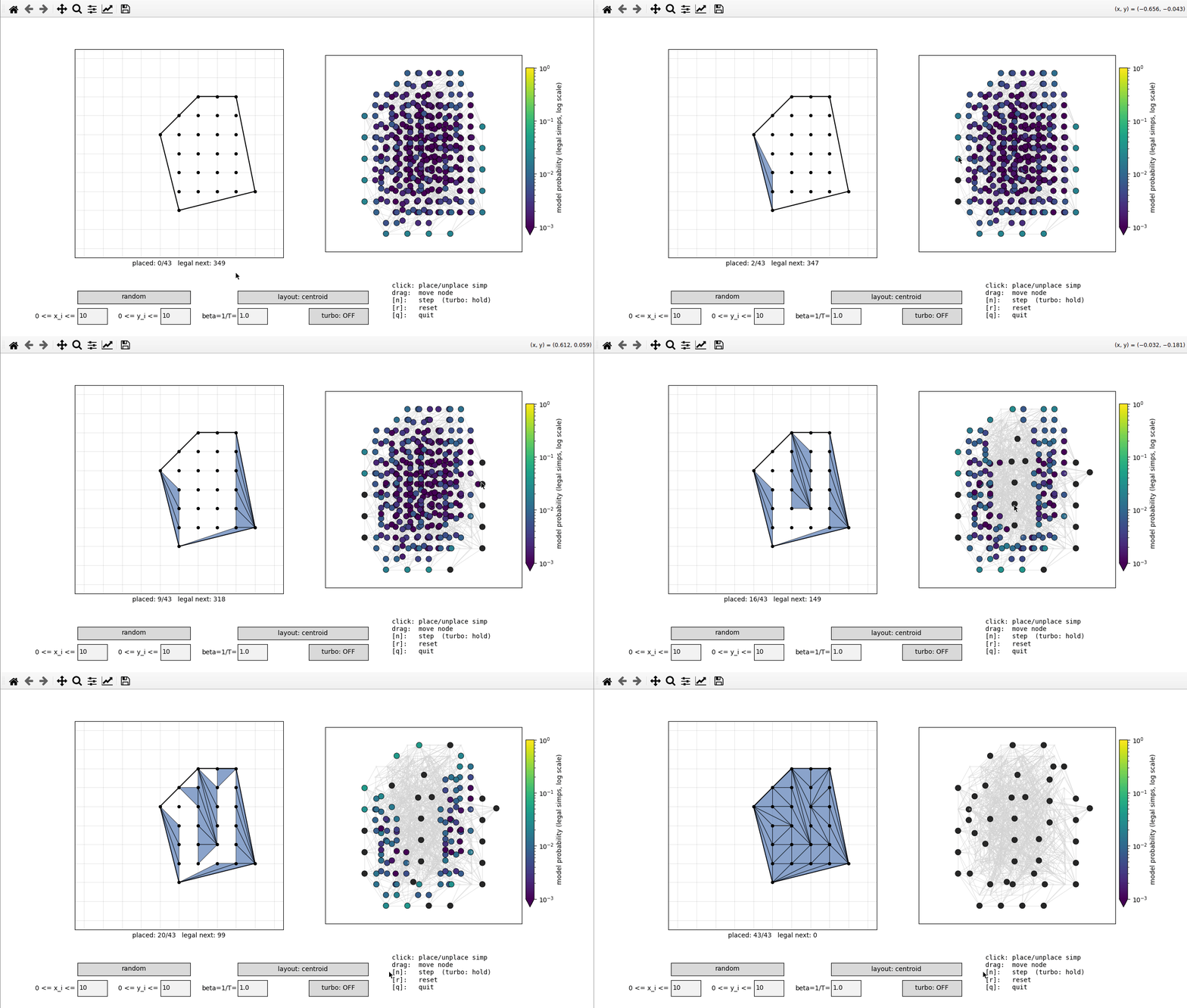
This repo contains a small graph-neural-network sampler for fine regular triangulations (FRTs) of convex 2D lattice polygons.
These FRTs are useful in string theory. More generally, they are a combinatorial population to sample from with nontrivial local and global constraints. At the time of writing this, the 'dualGNN' model in this repo is the most uniform sampler tested for polygons up to
The idea is to represent a triangulation
- having the model assign probabilities to the nodes (via message passing),
- sampling a node according to these probabilities, and then
- masking out nodes which cannot coexist with the newly chosen simplex.
To give the model enough information to do this, we encode the polytope's 'oriented matroid' via certain vectors corresponding to 'signed circuits' (see page 17 here or this wonderful book). The matroid characterizes the count of fine triangulations while our specific vectors (slightly richer than actual circuits) characterize the regularity of these triangulations (DRS). More so, circuits are invariant under the
This model is trained via supervised learning on a pool of fine regular triangulations. We allow bootstrapping of the pool (similar to CYTransformer) since the polygons of primary interest have too many triangulations to enumerate (otherwise, enumerating them and sampling from them would be preferable). We also fine-tune with REINFORCE.
The model
- is the most uniform sampler of FRTs tested (there are a few methods due to their application in string theory; we include some custom methods, too),
- is general (a single model can be trained that samples FRTs from arbitrary polygons),
- is small (~92k parameters; trained in ~7.5hrs; checkpoint attached to this repo),
- shows good inductive bias (generalizes zero shot), and
- is competitive in speed compared to the other tested samplers.
Most of the performance is attributed to the inductive bias. See the paper.
The major limitations are that this model was trained with
For string theory applications, it generates uniform samples (when paired with my NTFE algorithm) up to
The figures below are taken from the paper (included in this repo) and are
not directly reproducible from the code here; the repo ships inference and a small
uniformity demo (eval/uniformity/), not the full training and evaluation pipeline. See the
paper for methodology, hardware, and sample counts.
Zero-shot to a much larger polygon. The model, trained on the single triangle
flip_walk,
the only other sampler that reaches it; pushing/grow2d/fast are quicker but biased.
![KL vs sample time, zero-shot on [0,4]^2](https://raw.githubusercontent.com/natemacfadden/dualGNN/main/docs/figures/fig10_zeroshot_pareto.png)
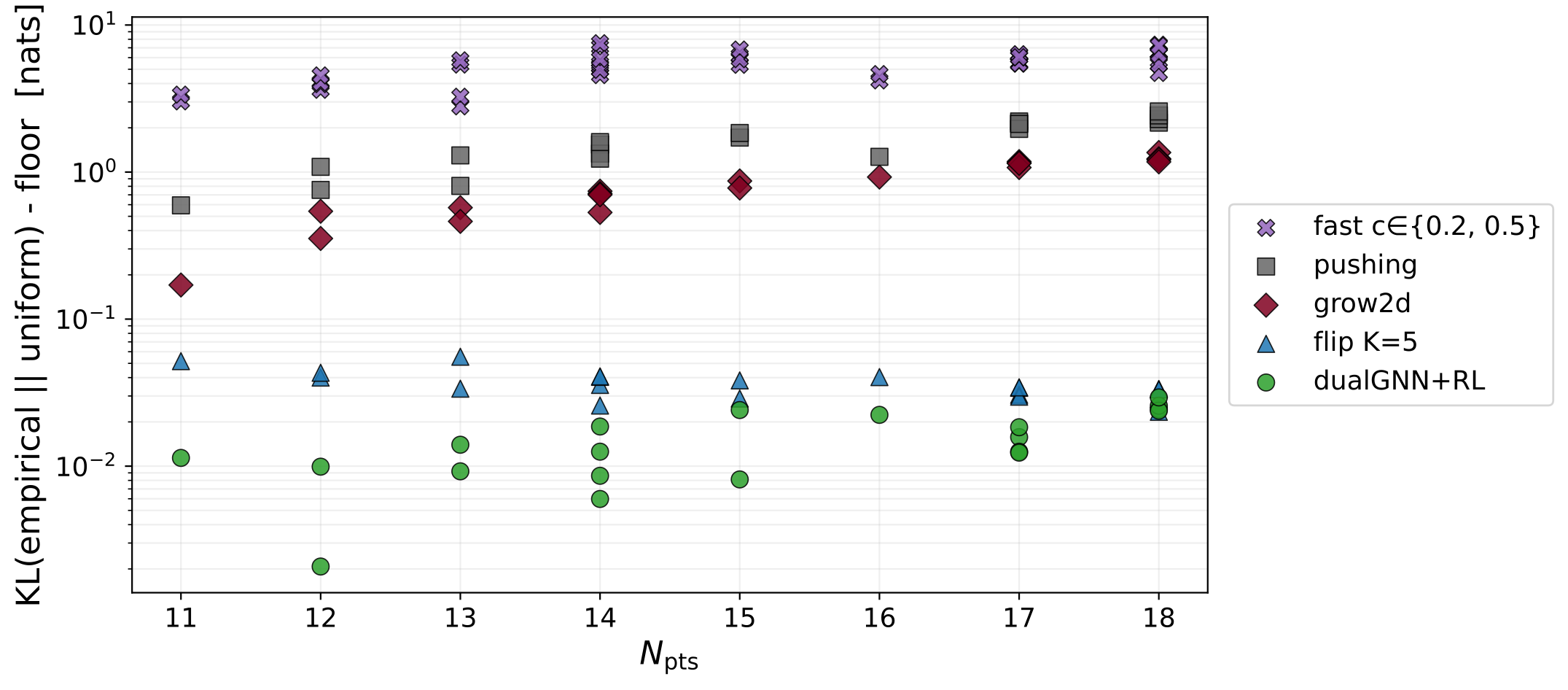
Most uniform across many polygons. Over flip_walk only at
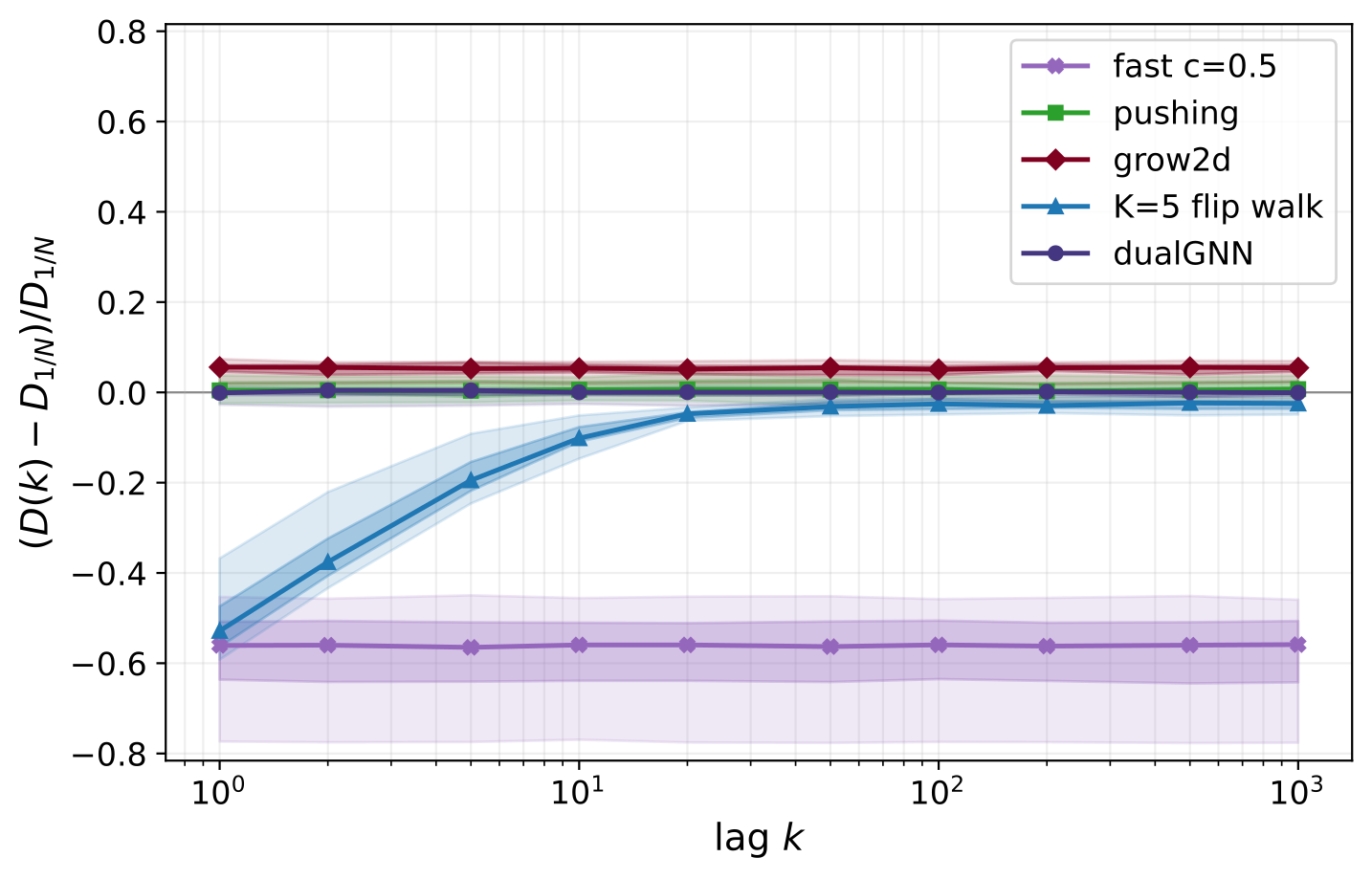
No sample autocorrelation. A good sampler's draws should be as far apart as independent
uniform draws. Plotting the flip distance between samples flip_walk's nearby
samples are correlated (closer together) until about
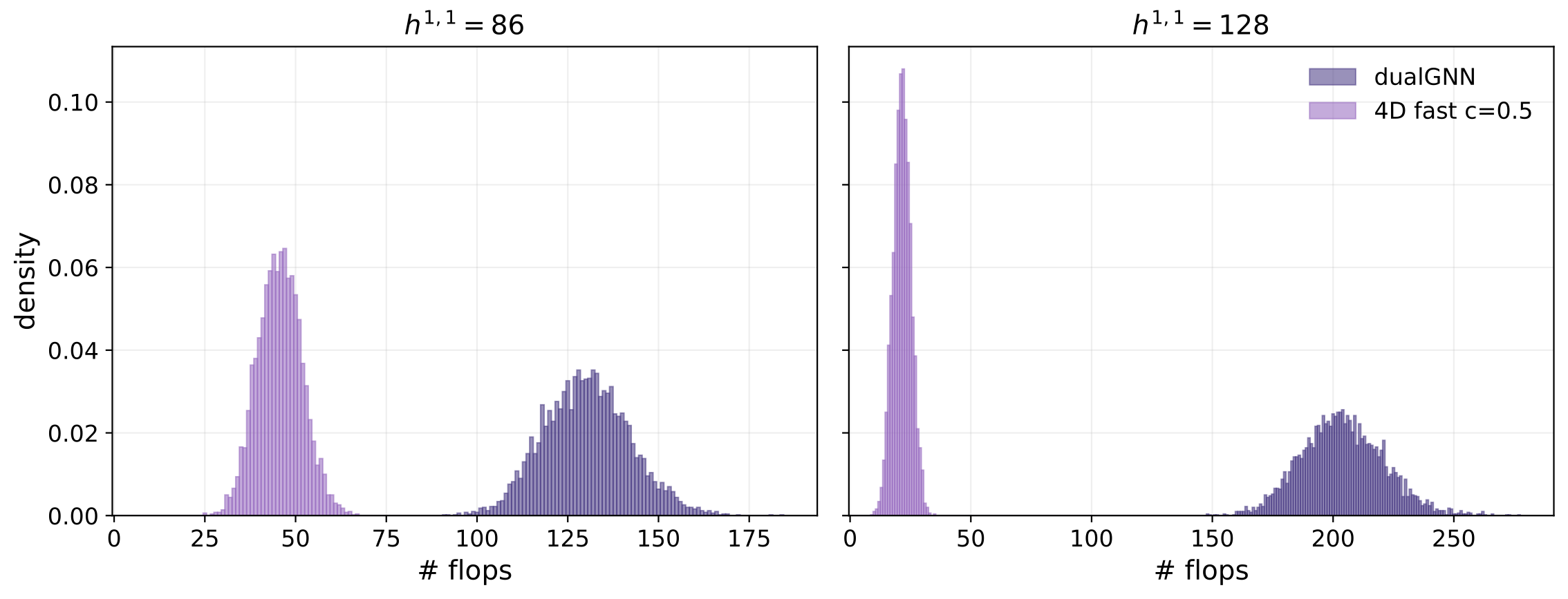
Downstream: more diverse Calabi-Yau samples. Combined into Calabi-Yau threefolds via the
NTFE algorithm, dualGNN's samples span far wider flop
distances than the de facto random_triangulations_fast (
Benchmark your own sampler against these results: the paper's 20
held-out polygons (with exact FRT counts) and the uniformity-scoring
protocol ship in eval/.
For inference (sampling with the shipped model):
pip install dualgnn
The model checkpoints ship inside the package. By default this pulls the standard PyTorch build, which on Linux bundles CUDA (a multi-GB download); on a CPU-only or Apple-silicon machine, install the matching wheel first (e.g. pip install torch --index-url https://download.pytorch.org/whl/cpu) then pip install dualgnn. The tutorials' plotting and the GUI additionally need matplotlib (pip install dualgnn[viz]); the NTFE pipeline additionally needs CYTools from the conda environment below.
For training (and development), use the conda environment -- the training pipeline needs CYTools, which pip cannot install (pip install dualgnn[train] fails on purpose and points you here):
conda env create -f environment.yml
conda activate dualgnn
One call samples deduplicated fine triangulations of a polygon with the shipped model (packaged as data -- works from any install, CPU included):
import numpy as np
from dualgnn import sample_frts

pts = np.array([[x, y] for x in range(5) for y in range(5)], dtype=np.int64)  # [0,4]^2
fts = sample_frts(pts, 8)                              # (<=8, 32, 3) int8
fts = sample_frts(pts, 8, only_regular=True, seed=0)   # FRTs only
The lower-level pieces are available too -- DualGNN.default() is the
shipped REINFORCE-finetuned model (cached per device), DualGraph the
candidate complex, and sample the raw with-replacement sampler:
from dualgnn       import DualGraph, sample
from dualgnn.model import DualGNN

net = DualGNN.default()                  # or DualGNN.from_ckpt(path)
fts = sample(net, DualGraph(pts), Ntriangs=8)          # (8, 32, 3) int8
Stable contract (downstream consumers, e.g. CYTools, assume this):
pts is the polygon's full lattice-point set as an (Npts, 2) int array,
and returned simplices index into pts in the caller's row order. Every
sample is a fine triangulation of the full point set, returned in canonical
form (vertex indices sorted within each simp, simps lex-sorted), so exact
duplicates compare equal under np.unique(axis=0). Regularity is learned,
not guaranteed -- filter with only_regular=True (or your own check) if
you need FRTs.
See tutorials/inference_demo.ipynb for a runnable version with plotting
(open it in Colab -- no install needed).
For comparison, two reference samplers are bundled (CYTools-free, both
return (simps, status)):
from dualgnn import grow2d, pushing

simps, status = grow2d(pts, seed=0)    # random fine triangulation
simps, status = pushing(pts, seed=0) # random fine pushing triangulationFor fun, we include a GUI demo (it's what's shown at the top of this README): python scripts/visualize.py. It allows you to build an arbitrary (or random) lattice polytope (left), build its graph
Pair the 2D sampler with the NTFE algorithm to sample fine, regular, star triangulations (FRSTs) of a reflexive 4D polytope:
import numpy as np
from cytools import Polytope
from dualgnn.model import DualGNN
from dualgnn.ntfe  import sample_ntfes

verts = [[-1, -1, -1, -1], [-1, -1, -1,  3], [-1, -1,  3, -1], [-1,  3, -1, -1],
         [ 1, -1, -1, -1], [ 1, -1, -1,  3], [ 1, -1,  3, -1], [ 1,  3, -1, -1]]
poly = Polytope(np.array(verts, dtype=np.int64))                           # reflexive, h11 = 86
net  = DualGNN.default()
heights = sample_ntfes(poly, net, N=20, N_face_triangs=1_000, n_workers=4) # (20, npts) float64
Each row is a height vector defining an FRST; pass as_triangs=True to get
CYTools Triangulation objects instead. See tutorials/ntfe_demo.ipynb.
The per-2-face FRT pools are identical across calls on the same polytope. To sample more NTFEs later without resampling them, ask the first call to hand the setup back, then feed it to the next call:
h1, ctx = sample_ntfes(poly, net, N=20, return_ctx=True)  # pools built once
h2      = sample_ntfes(poly, net, N=200, ctx=ctx)         # pools reused
(Calls sharing a ctx draw from the same finite pools, so they are not
independent across calls the way fresh-pool runs are.)
Requires the conda environment (
environment.yml) -- these scripts import CYTools, which pip cannot provide.
Three commands -- generate polygons, supervised train, REINFORCE fine-tune:
# 1) sample polygons (Npts 5..40, 3 per bucket); writes polygons.parquet
python scripts/make_polygons.py --out runs/data/polygons.parquet

# 2) supervised train (~5 h on a Blackwell-class GPU at 500k steps)
python scripts/train.py \
    --run-dir runs/sft \
    --src-polygons runs/data/polygons.parquet \
    --src-fts-dir  runs/data/fts \
    --n-steps 500000

# 3) REINFORCE fine-tune from the SFT final ckpt (~2 h at 10k steps)
python scripts/reinforce.py \
    --init-ckpt runs/sft/ckpt_0500000.pt \
    --run-path  runs/rl \
    --steps 10000
The FRT pool is auto-harvested per polygon on first use; you can also
pre-harvest a specific polygon via python scripts/harvest.py --poly-id N.
If you use dualGNN, please cite Sampling Triangulations and Calabi-Yau
Threefolds with Autoregressive GNNs:
@article{MacFadden:2605.27770,
  author        = {MacFadden, Nate},
  title         = {Sampling Triangulations and Calabi-{Y}au Threefolds with Autoregressive {GNN}s},
  year          = {2026},
  eprint        = {2605.27770},
  archivePrefix = {arXiv},
  primaryClass  = {hep-th},
  doi           = {10.48550/arXiv.2605.27770},
  url           = {https://arxiv.org/abs/2605.27770},
}
and/or this repository:
@software{dualGNN,
  author  = {MacFadden, Nate},
  title   = {dualGNN},
  year    = {2026},
  doi     = {10.5281/zenodo.20622920},
  url     = {https://github.com/natemacfadden/dualGNN},
  orcid   = {0000-0002-8481-3724},
}src/dualgnn/ library code (DualGraph, DualGNN, sampler, training)
src/dualgnn/ckpts/ shipped checkpoints, packaged as data (D32K16 SFT,
D32K16 + REINFORCE = DualGNN.default())
scripts/ CLI entry points (train, reinforce, harvest, make_polygons, visualize)
tests/ pytest suite (pip surface; NTFE tests need the conda env)
tutorials/ inference, NTFE demos (Colab-ready)
eval/ benchmark polygons, uniformity-scoring protocol, demo
docs/ paper, figures, GUI demo gif, Hugging Face model card