Cryptic binding pocket discovery via conformational ensemble analysis.






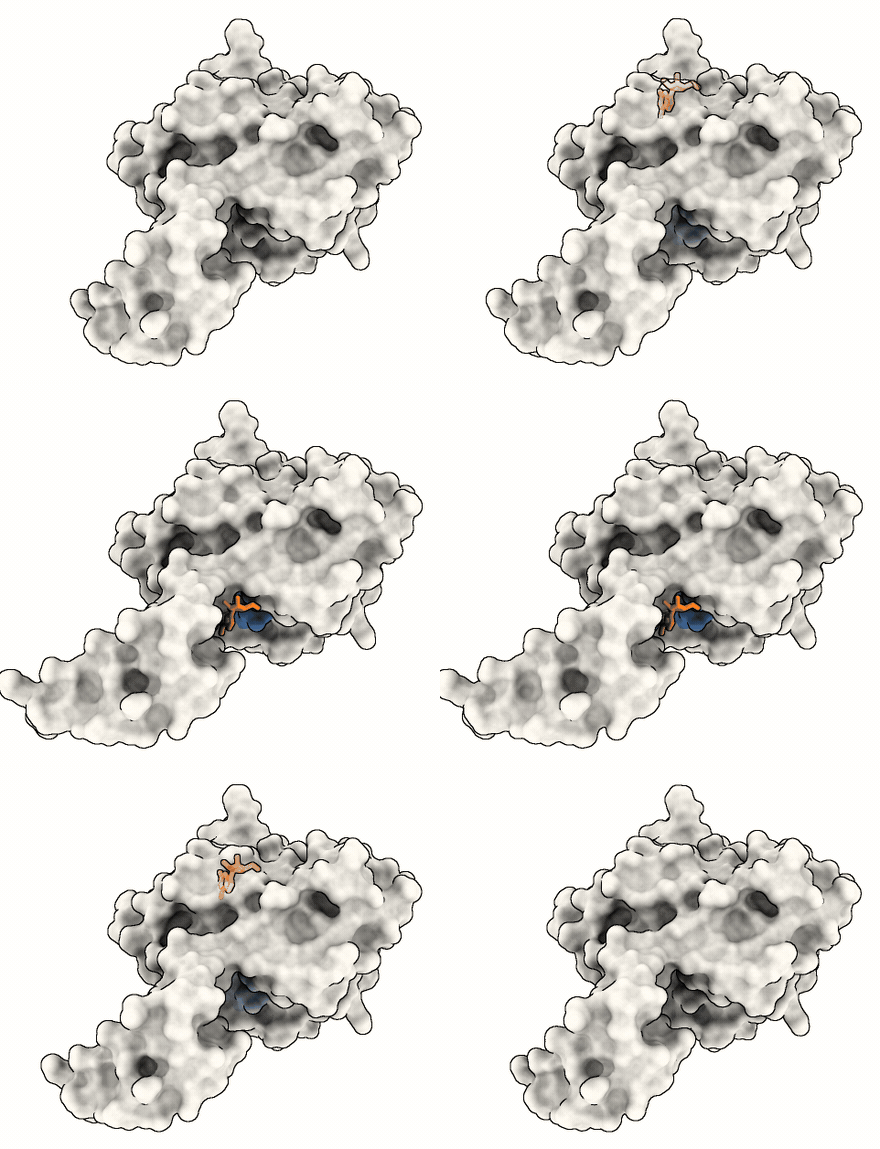
A protein breathes through Lacuna's conformational ensemble, and a cryptic pocket appears. Adenosine kinase along its lowest normal mode (Lacuna's NMA backend): as the interdomain cleft opens, the substrate pocket (blue) is exposed and 2-fluoroadenosine (orange, the crystallographic ligand from holo 2PKK) docks into it. The motion is Lacuna's own mode-0 ensemble; the ligand is shown at its bound pose.
Most protein structure predictors return one static conformation. But many disease-relevant proteins are called undruggable not because they are biologically intractable, but because no pocket is visible in their ground state. K-Ras was considered undruggable for thirty years until a transient cryptic pocket was found beneath its switch-II region. That pocket now backs sotorasib and adagrasib.
Lacuna finds those pockets. It generates a conformational ensemble from any input structure, detects pockets in every conformer, clusters them across the ensemble to surface sites that appear only transiently, and ranks them with a fitted model.
lacuna discover kras.pdb --conformers 20 --emit-boltz-constraints --emit-vina-boxespip install lacuna-pocketsOptional extras, for better conformational sampling or the sequence-assisted ranker:
pip install "lacuna-pockets[openmm]"   # 100ps implicit-solvent MD
pip install "lacuna-pockets[plm]"      # PLM-assisted ranker (PyTorch, ESM-2)
pip install "lacuna-pockets[boltz]"    # Boltz-2 diffusion sampling (experimental, GPU)
pip install "lacuna-pockets[all]"      # everything
Requires Python 3.10+. The default backend needs no GPU, no force field and no model weights.
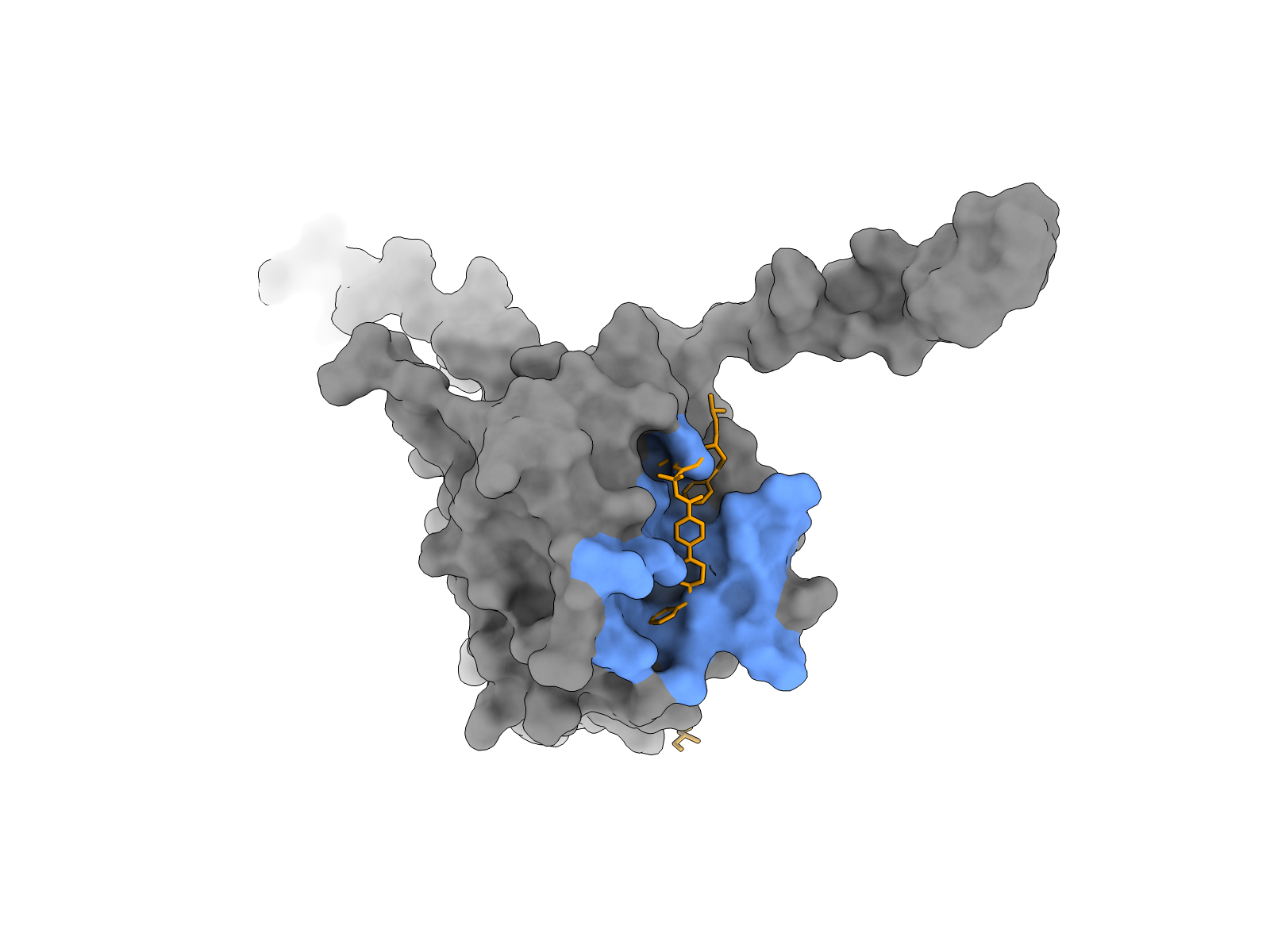
Apo BCL-XL (1LXL): a Lacuna-detected pocket (blue) opening onto the
groove where ABT-737 (orange, from the holo structure 2YXJ) binds, a site never shown to
the detector. With --detector surface-fusion this site is recovered at rank 2,
Jaccard 0.36, centroid 5.6 Å. The default alpha detector places it third and
does not clear the size-robust bar, which is the specialisation this release is about.
lacuna discover protein.pdb --conformers 20Writes a ranked pocket_report.json plus, on request, Boltz YAML constraints
and AutoDock Vina boxes ready for docking. Full options in
docs/USAGE.md.
- Ensemble generation. N conformers from elastic-network normal mode analysis (default), OpenMM implicit-solvent MD, or Boltz-2 diffusion sampling.
- Pocket detection. Grid-based alpha-point analysis per conformer: distance transform, local maxima in the 1.4-5.5 A interaction zone, clustered into candidates.
- Cross-ensemble clustering. Greedy centroid merging matches corresponding pockets across every conformer, turning transient cavities into persistent sites with their own statistics.
- Druggability scoring. Gaussian volume reward centred at 300 A³, plus enclosure, hydrophobicity and aromaticity (Halgren 2009), scored per conformer.
- Ranking. A fitted linear model over 23 geometric and ensemble-derived features orders the sites. Each also carries a continuous crypticity score.
| Usage | CLI, Python API, backends, output formats, worked example |
| Ranking | Ranking strategies, the fitted model, crypticity |
| Benchmarks | Full results, head-to-head comparisons, negative results |
| Paper | Analysis, per-candidate data, and scripts that regenerate every figure |
On CryptoBench's designated test fold, Lacuna recovers 55.6% of known cryptic sites in its top five with the zero-dependency default and 66.1% with the optional PLM-assisted ranker, and the true site is present in the candidate set for up to 92% of structures.
Cryptic-pocket recovery on CryptoBench's held-out test fold, under the size-robust criterion (Jaccard >= 0.25, or centroid within 4 A of the site).
| Configuration | Top-5 recovery | Site found (coverage) |
|---|---|---|
| Default (CPU-only, zero-dependency) | 55.6% | 73.7% |
| + PLM reranker | 66.1% | 73.7% |
surface-fusion detector |
73.9%¹ | 86.4%¹ |
| Union across detectors | n/a | 92.2% |
¹ Held-out surface-fusion evaluation at 5 conformers (n=184); the other rows use the 20-conformer cohort (n=180).
Full results, including head-to-head comparisons and where Lacuna loses →
The more interesting result is not Lacuna's score. Across five candidate-generation methods evaluated in six configurations, coverage (whether a qualifying candidate is proposed at all) spans 14.5 points, while conversion (whether a method's own coverage reaches the top five) spans 36.7. fpocket has the highest coverage at 73.7% but the lowest top-5 recovery at 43.6%, while P2Rank converts 95.8% of the sites it covers. Two Lacuna rankers operating on the exact same candidate set differ by 10.6 points of top-5 recovery, isolating ranking directly.
Union coverage saturates at 92.2%, rising to 98.6% for annotated sites containing at least eight residues. Candidate competition is also causal: adding synthetic competitors while holding the true site, real candidate set, and ranker fixed reduces top-5 recovery by 16.8 points on the training folds and 17.0 points on the held-out test fold. Detector consensus provides no measurable gain at a budget of five candidates, but gains 11.8 points at a budget of twenty.
Moore CW. Cryptic binding sites are detected but not ranked: coverage, conversion, and the limits of detector consensus. bioRxiv 2026. doi:10.64898/2026.08.11.743381
If you use Lacuna, please cite the software paper:
@article{moore2026lacuna,
  author  = {Moore, Clayton W.},
  title   = {Lacuna: Cryptic Binding Pocket Discovery
             via Conformational Ensemble Analysis},
  journal = {bioRxiv},
  year    = {2026},
  doi     = {10.64898/2026.08.14.744956}
}
If you use the benchmark data or the coverage/conversion decomposition, please also cite the accompanying analysis:
@article{moore2026coverage,
  author  = {Moore, Clayton W.},
  title   = {Cryptic binding sites are detected but not ranked:
             coverage, conversion, and the limits of detector consensus},
  journal = {bioRxiv},
  year    = {2026},
  doi     = {10.64898/2026.08.11.743381}
}
To cite a specific software version, the archived releases carry their own DOIs under the concept DOI 10.5281/zenodo.20533638, which always resolves to the newest.
Lacuna is measured against, and builds on, work released openly by others: fpocket (Le Guilloux et al. 2009), P2Rank (Krivák & Hoksza 2018), IF-SitePred (Carbery et al. 2024) and MDpocket (Schmidtke et al. 2011). Evaluation uses the CryptoBench (Škrhák et al. 2025) and PocketMiner (Meller et al. 2023) datasets. Method credits: ANM (Atilgan et al. 2001), SiteMap druggability (Halgren 2009), enclosure scoring (Schmidtke & Barril 2010), ESM-2 (Lin et al. 2023).
MIT, free to use, study, modify, share, and embed in closed-source or commercial work, with no copyleft obligation.
Versions 0.2.0 through 0.3.1 were released under AGPL-3.0 and remain available under those terms. MIT applies from 1.0.0 onward. Lacuna moved back to a permissive license because its central recommendation is to combine several detectors, and copyleft makes that combination harder for exactly the people the work is aimed at.