
An LLM inference engine in Rust, from the HTTP server down to the CUDA kernels — and a drop-in llama-server for it.
Your OpenAI client works unchanged. bloomery speaks llama-server's HTTP API and reads the same files:
- The API:
/v1/chat/completions,/completion, streaming, tool calls,reasoning_content,cache_prompt,/tokenize,/detokenize,/slots,/metrics,/v1/models,/props. OpenAI SDKs, curl, and llama-server tutorials apply as they are. reasoning_budget, per request on/v1/chat/completionsand/completion: llama-server's--reasoning-budget— the think span's budget in generated ids taken while the span is open,0closing it at once,-1or absent unrestricted, and silently ignored when the template already closed the span.- The files: the GGUF uploads as downloaded, the same quantizations, the chat template read from the file,
and a tokenizer bit-identical to
llama-tokenize. - The flags:
-m/--model-file,--hf <repo>[:<quant>](download, resume, sha256 check, never fetched twice),--parallel/-np,--queue-depth,--cache-ram,--ctx/--ctx-size(the qwen3, qwen38 and glm seats default it to what the card's free memory fits — the trained context capped to it on the qwen3 seat's whole-card loads, the largest context that keeps the card's experts on the qwen38 seat, the placed plan's margin on the glm seat),--cache-type-k f16|q8_0(the qwen3 seats; llama-server's spelling, also theBLOOMERY_QWEN3_KVlever — q8_0 halves the KV bytes a position, so the auto context nearly doubles on the same card;--cache-type-vdoes not exist, both planes quantize together),--host/--port,)--alias. - Two-card serving like
-ts:--place afor the largest visible card,--place bpto add the next one as an expert tier, or a list (0+1) by CUDA index. - Clef-Flash's
/v1/systemonefollows llama.cpp's decision server wire (modeloptional,/v1/models, 501 for images and video, upstream'sconfidenceformula).
Where it ends today: one model a server, sm_86+ GPUs, and the seats' own defaults where llama-server has none (see Limits).
Prebuilt, one binary, no CUDA toolkit and no Rust toolchain — Linux x86-64 with AVX2/FMA (x86-64-v3), glibc
2.34+, an NVIDIA GPU of compute capability 8.6 or newer and its driver. On Windows, run it inside WSL2
(wsl --install, reboot, then the same commands in the WSL shell). What each model needs in GPU, RAM and
disk: Hardware.
Three ways to get it:
# Homebrew (Linux x86-64)
brew install midagedev/tap/bloomery

# or the installer: latest release, sha256-checked, symlink into ~/.local/bin
curl -fsSL https://raw.githubusercontent.com/midagedev/bloomery/main/tools/release/install.sh | sh

# or Docker (needs the host's NVIDIA Container Toolkit; model downloads live in the bloomery-cache volume)
docker run --gpus all -p 8080:8080 -v bloomery-cache:/root/.cache/bloomery \
  ghcr.io/midagedev/bloomery --hf unsloth/Qwen3-30B-A3B-Instruct-2507-GGUF:Q4_K_M
The plain tarball, when you want to lay it down yourself:
tar -xzf bloomery-0.2.0-linux-x86_64-cuda-sm86.tar.gz && cd bloomery-0.2.0-linux-x86_64-cuda-sm86
bin/bloomery-serve --hf unsloth/Qwen3-30B-A3B-Instruct-2507-GGUF:Q4_K_M --port 8080From source: docs/BUILD.md (Linux x86-64, CUDA 13.3, LLVM/Clang 21, cargo-oxide from our
cuda-oxide fork).
One binary, five seats. With -m or --hf and no --model word, the file's architecture picks the seat
(--help lists them, one line each with a working --hf example):
| Seat | Serves | One command |
|---|---|---|
ds41 |
DeepSeek-V4.1-Flash | bin/bloomery-serve --hf vcruz305/DeepSeek-V4.1-Flash-GGUF:Q3_K_M |
glm |
GLM-5.3-Flash | bin/bloomery-serve --hf unsloth/GLM-5.3-Flash-GGUF:UD-Q4_K_XL |
qwen38 |
Qwen3.8-Flash-Next | bin/bloomery-serve --hf unsloth/Qwen3.8-Flash-Next-GGUF:UD-Q4_K_XL |
qwen3 |
Qwen3.6-35B-A3B, Qwen3-30B-A3B | bin/bloomery-serve --hf unsloth/Qwen3-30B-A3B-Instruct-2507-GGUF:Q4_K_M |
decide |
Clef-Flash (a decision model) | bin/bloomery-serve --hf bartowski/Cloudflare_clef-flash-GGUF:Q5_K_M |
The generative seats answer /v1/chat/completions and /completion, streaming, and reuse a cached prompt
prefix:
curl -s http://127.0.0.1:8080/v1/chat/completions \
  -d '{"messages": [{"role": "user", "content": "Hello"}], "max_tokens": 64}'
The decide seat answers SystemOne requests, one at a time, text states only:
curl -s http://127.0.0.1:8080/v1/systemone -d '{"state": "User: what is the weather in Seoul tomorrow? Tools available: web_search, calculator.",
  "questions": {"tool": {"type": "choice", "instructions": "Which tool should the agent call next?",
    "criteria": {"web_search": "Look something up online", "calculator": "Do arithmetic", "none": "Answer directly"}}}}'
Concurrent requests. The ds41, glm, qwen3 and qwen38 seats take --parallel N: requests take
turns of 64 tokens on one model, a later arrival preempts at the next step, and both answer their
solo runs' tokens exactly — V4.1, GLM and Qwen3.8 by snapshot/resume (their MTP drafts rejoining),
the qwen3 seats by re-prefill. Unset, the ds41, glm and qwen38 seats size the slots to what the
park budget holds of one slot's whole-context state (a parallel line on stderr names the rule,
the slots and each term; never below one, and --parallel 1 keeps the plain engine); the qwen3
seats keep two (their park holds ids only, nothing to size from). The N slots
share one context-sized cache in turns (llama-server gives each slot its own full n_ctx, N times the memory —
a different resource reading of the same flag, not a defect).
Small cards. Qwen3.6 and Qwen3-30B at Q4_K_M (19-21 GB) run whole on a 24 GB card, or on a 12-16 GB card
with --place a: the routed experts go to the CPU. With no --place at all, a file that does not fit the
card's free bytes plans that split itself and says so on its plan line.
A plan that fits the card you have. The load reads each card's free bytes and the host's available RAM before anything uploads; the expert share sizes to them, and a plan that cannot fit is refused by name with every term (dense, KV, context, scratch, margin) and the processes holding the card — before minutes of loading, not after.
Speculative decoding. BLOOMERY_DRAFT=mtp drafts with the model's own MTP head (Qwen3.8 and GLM-5.3, on by
default in their servers); BLOOMERY_DRAFT=dspark drafts V4.1 with DeepSeek's DSpark head on a second card
(--place bp).
Adaptive residency. V4.1, Qwen3.8 and GLM-5.3 count their own routing as they run and swap routed experts
between the card and the host between steps; a prompt call streams its hottest host experts onto the card, so
decode starts warm (on by default under --place a/bp).
The engines behind the server. generate_ds41 takes token ids and prints greedy ids; bloomery-chat
streams text; bloomery-serve-ds41 and bloomery-serve-qwen38 are the standalone V4.1 and Qwen3.8 servers.
Every seat and flag is its binary's --help.
| Model | Recommended file | How it runs |
|---|---|---|
| DeepSeek-V4.1-Flash | Q3_K_M (vcruz305) |
GPU + CPU experts; 256 GB of RAM |
| GLM-5.3-Flash | UD-Q4_K_XL (unsloth) |
GPU + CPU experts; sparse attention past 2,051 positions |
| Qwen3.8-Flash-Next | UD-Q4_K_XL (unsloth) |
GPU + CPU experts |
| Qwen3.6-35B-A3B | Q4_K_M (lmstudio-community) |
whole on one 24 GB card, or --place a on 12-16 GB |
| Qwen3-30B-A3B-Instruct-2507 | Q4_K_M (unsloth) |
whole on one 24 GB card, or --place a on 12-16 GB |
| Clef-Flash | Q8_0 to Q3_K_S (bartowski), plus the release's head file |
whole on one GPU, its head on the CPU |
| DeepSeek-V2-Lite-Chat | Q3_K_M (mradermacher) |
CPU or GPU; the first model, still gated |
Each file is the public upload as downloaded; the downloads are checked against the uploads' sha256. How close each Clef quantization answers to the BF16 release, per question: agreement table. The DSpark draft for V4.1 is converted from DeepSeek's checkpoint (the converter in llama.cpp's V4.1 pull request).
Single-stream tok/s on the development machine (an RTX A6000 48 GB and a 32-core AVX2 CPU; decode n = 96).
Every number comes from the runners in tools/ref/ under the quiet-machine protocol, and every measured row,
the other engines, and progress over time live on rig-log's bench page.
Against llama.cpp, DeepSeek-V4.1-Flash Q3_K_M (pull #28696 at its fastest
flags, 2026-09-28, conditions and caveats — a warm
re-measure replaces these rows):
| A6000, tok/s | bloomery | llama.cpp | ratio |
|---|---|---|---|
| decode, depth 6 | 29.66 | 22.75 | 1.304 |
| decode, depth 4096 | 30.04 | 21.78 | 1.379 |
| prompt, P = 512 | 190.6 | 104.9 | 1.817 |
| prompt, P = 4096 | 358.4 | 76.5 | 4.68 |
On this machine, today's defaults (per-row conditions in rig-log):
| Model | Decode | Prompt |
|---|---|---|
V4.1-Flash Q3_K_M, A6000 + CPU |
43.30 after P = 512, 36.77 after 4096 | 191.97 (P = 512), 376.67 (P = 4096) |
V4.1-Flash, A6000 + 3090 (--place bp) |
44.28 / 37.45 | 205.48 / 388.93 |
GLM-5.3-Flash UD-Q4_K_XL, A6000 + CPU |
20.95 (depth 512) | — (the batched prompt and the MTP draft landed after this window) |
Qwen3.8-Flash-Next UD-Q4_K_XL, A6000 + CPU |
91.24 after P = 512, 79.33 after 4096 | 861.7 (P = 512), 1,024.3 (P = 4096) |
Qwen3.6-35B Q4_K_M, A6000 whole |
204.4 (depth 6), 195.8 (depth 4096) | 6,464 (P = 512), 8,311 (P = 4096) |
Qwen3-30B Q4_K_M, A6000 whole |
209.2 (depth 6), 175.2 (depth 4096) | 7,827 (P = 512), 9,276 (P = 4096) |
A first start compiles the GPU code for the card (tens of seconds); later starts take seconds. A warm V4.1 load takes about 16 s.
- More than 200 CUDA kernels, all written in Rust with cuda-oxide (how).
- Experts on the GPU and the AVX2 CPU in one CUDA graph step; V4.1's batched prompts leave the state of one step per token, bit for bit.
- Adaptive residency: routed experts move between the card and the host by the engine's own routing as it runs; V4.1's engram table is read from NVMe, 48 rows a token, prefetched by a helper thread.
- Speculative decoding with greedy output unchanged: DSpark for V4.1 (the draft on a second card), the MTP head for Qwen3.8 and GLM-5.3.
- Prompts run batched — V4.1 in batches of up to 512 positions with two in flight so the card and the CPU overlap, the Qwens through an int8 tensor-core GEMM in ubatches of up to 4096 tokens.
- A load streams the file's bytes to the card through a pinned ring with one sync.
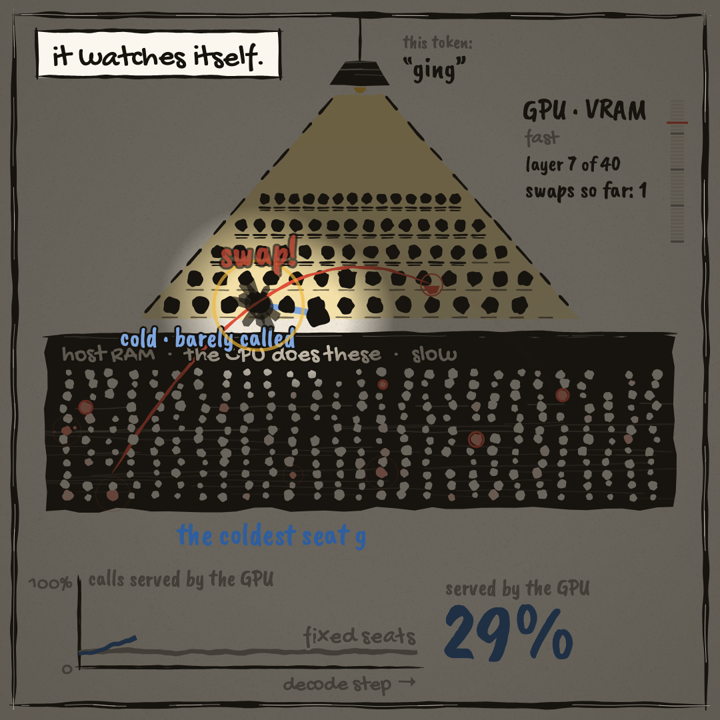
Adaptive residency on one A6000, V4.1 Q3_K_M, 96 decode steps after a 512-token prose prompt: 29.48 tok/s
with it off, 35.70 with the swap rule, 43.86 with the prompt call's streaming as well (the default). The card
served 18 % of the routed calls with it off; with streaming it served 57 % over the first 16 steps and 71 %
over the last 16 (rig-log).
- Against ik_llama.cpp. Intermediate tensors are dumped from its CPU backend and compared per layer. Integer outputs (router ids, engram rows, indexer top-k) match exactly outside tie bands; float outputs stay inside bands derived from both engines' rounding. On the public V4.1 file: PPL 2.2401 against ik's 2.2378, KLD 0.00987, same top token 97.46 %.
- Against Cloudflare's own Python, for Clef. The request encoder's token ids equal the release's; the
head's logits stay within 2e-5 of an f64 copy of the release's head; the backbone's hidden states gate
against llama.cpp mainline's final-norm rows. End to end, the top option equals the BF16 release's on 29 to
31 of 31 questions for every bartowski file from
Q8_0down toQ3_K_S— every miss a question the release itself answers within 0.02 of a tie (table). - Bit gates. Graph replay equals eager execution; the skewed pass equals two single steps; a rollback and a V4.1 batched prompt leave the same state as one step per token.
- Each gate is shown to fail on its defect before the fix lands. Bands are not relaxed to pass.
Required of every host: an NVIDIA GPU of compute capability 8.6 or newer and its driver; a CPU with AVX2 and FMA (the prebuilt archive targets x86-64-v3); glibc 2.34+; Linux, or Windows through WSL2. NVMe is recommended — a load streams the file to the card, and V4.1 reads its engram table from disk as it runs.
What each model needs:
| Model | GPU | Host RAM | Disk (the file) |
|---|---|---|---|
| Clef-Flash | 12 GB covers every quantization (the files run 4.26–9.55 GB) | any | 4.3–9.6 GB, plus the head (243 MB, fetched) |
Qwen3.6-35B Q4_K_M |
24 GB whole, or 12–16 GB with --place a |
32 GB whole; about 10 GB free beside a small card | 21.2 GB |
Qwen3-30B Q4_K_M |
24 GB whole, or 12–16 GB with --place a |
32 GB whole; about 8 GB free beside a small card | 18.6 GB |
| Qwen3.8-Flash-Next | 24 GB recommended (the expert share sizes to the card's free bytes) | 256 GB | 111.3 GB, plus the 2.8 GB MTP draft |
| GLM-5.3-Flash | 24 GB recommended | 256 GB | 199.7 GB |
| DeepSeek-V4.1-Flash | 24 GB recommended | 256 GB | 347.3 GB, plus 155.7 GB for the optional r8 sidecar |
Recommended (the configuration every number in this README ran on): a 32-core AVX2 CPU with 8 DDR4
channels, 256 GB of RAM, an RTX A6000 48 GB, and an RTX 3090 24 GB beside it for --place bp. Cards are found
by device, not by name; a list word such as 0+1 names cards by CUDA index (CUDA_DEVICE_ORDER=PCI_BUS_ID
matches nvidia-smi's numbering).
Only the A6000, the 3090, and an RTX 3060 12 GB under WSL2 (running Clef-Flash, its download and its cache)
have been run; other cards and drivers are untested — please open an issue with --version and the error
text. Costs per part: docs/HARDWARE.md.
- sm_86+ GPUs; the prebuilt archive carries sm_86 PTX.
- One model a server; one expert tier card at most (
--place bp). - The qwen38 and decide seats serve one request at a time (Qwen3.8's MTP draft does not rejoin a turn yet);
DSpark drafts never rejoin —
--parallel > 1withBLOOMERY_DRAFT=dsparkis refused by name. - Clef takes text states only, and reads backbone weights of Q3_K, Q4_K, Q5_K, Q6_K, Q8_0 and F32 (not the IQ types, Q2_K, Q4_0 or Q4_1).
- V4.1 prompts are bound by the CPU expert tier; V4.1 decode is bound by host memory bandwidth.
- A pinned nightly with a pinned cuda-oxide revision from our fork (
docs/BUILD.md).
In progress: serving on N cards for every model; Clef from the IQ and Q2_K files; DeepSeek-V4-Flash-0731.
See docs/BUILD.md: the toolchain and one command block per model (download, build,
generate, serve, and --place gate on a single RTX 3090). In short: Linux x86-64, CUDA 13.3, LLVM 21 and
cargo-oxide from our cuda-oxide fork, then cargo oxide build --arch sm_86 -- -p bloomery-gpu-gates --features deepseek41 --release --bin generate_ds41.
- ik_llama.cpp: DeepSeek-V4.1 support (#2455),
GGML_CUDA_NO_PINNED_WEIGHTS(#2444), V4.1 DSpark drafts (#2522, #2546), and eleven more fixes, merged; #2507 and #2562 open. - cuda-oxide: #1314 and
#1321 merged;
#1329 and
#1346 open. Unfiled toolchain issues:
docs/upstream/nvlabs-ledger.md. - llama.cpp #29008 merged; mistral.rs #2430 and cutile-rs #309 open.
- How bloomery uses cuda-oxide:
docs/cuda-oxide.md. Plan and cost models:docs/plan.md; GPU design:docs/gpu-design.md. - Measurements and command lines: rig-log (Korean).
- Recorded sessions, not benchmark rows: V4.1 on two cards answering a coding review; GLM-5.3's server at its defaults against llama.cpp's GLM pull request on the same card; Clef-Flash answering seven Korean SystemOne requests.
- Working contract:
AGENTS.md,CONTRIBUTING.md.
ik_llama.cpp and ggml are the numerical reference: the kernels
were written by reading ggml's k-quant code and ik_llama.cpp's iqk_mul_mat, and accuracy is defined against
their output. exllamav3 and
mistral.rs are design references, cited where used. All four are
MIT. The GPU kernels compile with cuda-oxide (Apache-2.0).
AI assistants helped write the code and the documentation. Every number here was measured by the runners in
tools/ref/.
MIT, see LICENSE. crates/oxide-ice-unroll carries NVIDIA's Apache-2.0 headers. Third-party
notices are in THIRD_PARTY_NOTICES.md.