This is a list of comments I've either made at meetings or written to public officials.
I'm making this list public because I shared a letter once and it ended up on Slate/Mother Jones, so it seems useful.
The most useful thing to do is to call on the phone or show up in person if there is an opportunity for public comment and tell your elected officials what you think.
Short of this, you can use this emailer to send messages to your elected officials - it sends one email at a time to each person on the list, so it looks like they're personalized.
-
We've failed to build housing to keep up with the numbers of jobs we're creating (see per-county stats below). This leads to high prices and longer commutes.
-
Prices are really, really, high, and hard to deal with:
- One in three CA renters pays more than half their income to their landlord.
-
I would rather deal with an X crisis (parking, traffic, zucchini) than a housing crisis.
-
Building infill housing close to transit is good for the environment. Dense housing uses less water; SF County has lowest per-person water use in the state. See water-usage.md.
-
The fastest growing cities in the Bay Area are Brentwood, Gilroy, Rio Vista, all out in the suburbs, all single family homes with lawns, mostly people with long commutes. We should be building more infill development instead of pushing people to the outskirts of the Bay Area.
-
Building housing lowers rents - SF built 5000 units last year and saw rents drop.
-
Areas that build the most housing relative to population change see the lowest price increases: https://twitter.com/lenkiefer/status/871785655164182529
-
From 2000-2015 Seattle built 9 times as much housing as Oakland; also has rents at half Oakland's level.
-
Reducing the amount of housing raises rents: “After Hurricane Katrina hit New Orleans the apartment vacancy rate plummeted to 2.7% from 6.7% and rents rose by more than 30%”
-
-
Lower rents are more equitable - "rising housing prices in high-income areas deter low-skill migration and slow income convergence" http://www.nber.org/papers/w23609
-
Building housing lowers move-in evictions - SF built 5000 units last year, a record, and owner move-in evictions dropped. If new market rate units caused evictions, it would be hard to explain why they dropped when SF built a record amount.
-
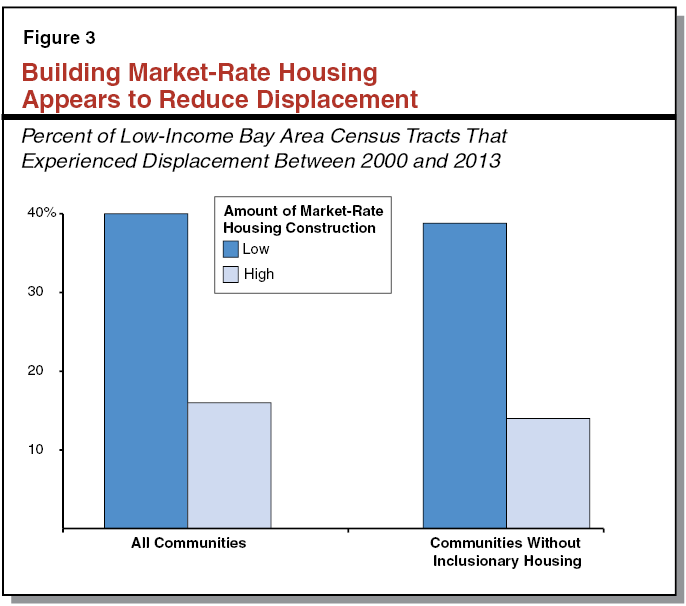
Building more housing reduces displacement. - "Lower Costs Reduce Chances of Displacement," http://www.lao.ca.gov/Publications/Report/3345
-
Lack of housing construction is a public health emergency
-
Santa Clara County homeless population under 25 tripled from 2015 to 2017. "A lot of it has to do with the lack of affordable housing.. A generation ago someone could literally find a room with a roommate for $75 a month. Now you can't find that for $750 a month. They're just out of luck — that’s the new reality."
-
83 percent of homeless residents lived in Santa Clara County at the time they became homeless.
-
50 RV's along El Camino Real in Palo Alto. Including a family that owns a home in Stockton but couldn't find work there, tired of the commute.
-
People taking all night buses because they don't have a place to live.
-

Only 4% of San Francisco renters are in subsidized below-market-rate housing. The rest of the city, including the majority of people making below the area's annual median income, rent in units that reset to the market rate when a new tenant moves in.
"Market rate" also counts units that rent for less than the average - a Richmond house built in 1940 that rents for $1000 a month is "market rate".
A 1% increase in the market rate rent translates to an extra $20 million per year paid by tenants to landlords. 13% of tenants move each year; these 13% paying an extra 1% translates to $20 million. Over 15 years, as more people move and start paying the extra 1%, the total transfer from tenants to landlords is $1.5 billion. (All numbers according to San Francisco's chief economist)
-
If neighbors are concerned with a project that complies with existing zoning, they should purchase an easement that prevents the property owner from (building too tall/casting a shadow/replacing a tree). If they do not do that the Planning Commission should conclude that the property owner values the housing more than the neighbors value sunlight. There is no need for the Planning Commission to get involved.
-
There is no "right to sunlight" in the USA. Making decisions based on sunlight for neighbors implies your neighbors have some sort of covenant over your property above and beyond what the zoning code says. This is unfair to the property owner.
-
By amending or delaying a project that complies with zoning codes we are rewarding the neighbor for a lack of knowledge of zoning codes and foresight about the types of buildings that might be built nearby.
The Housing Accountability Act (HAA) ties cities hands in important ways - often times they are legally required to issue permits to projects. See HAA.md for more info.
It is illegal under CA Government Code 65996 for a local government to take any decision on the grounds that schools would be insufficient. E.g. you can't argue that "schools would be overcrowded" to deny a project.
Homelessness is largely a problem in cities with high housing prices. Cities without high housing prices see much lower rates of homelessness.
Two thirds of SF's homeless population lived in SF before becoming homeless. 55% of those were here longer than ten years.
SF is half as dense as Brooklyn and a lot of SF is zoned for single family housing. Look at this chart for example - we have a lot of very low density close to BART and SFMUNI lines. https://twitter.com/graue/status/868001323685302272
In SF and Oakland we've added 17 new jobs for each new housing unit permitted. This points to a problem of insufficient housing supply.
Jobs data comes from https://data.edd.ca.gov/Labor-Force-and-Unemployment-Rates/Local-Area-Unemployment-Statistics-LAUS-Annual-Ave/7jbb-3rb8
"Jobs" is counting the number of employed people.
Housing numbers come from http://www.dof.ca.gov/Forecasting/Demographics/Estimates/E-5/, which are saved as the Excel spreadsheet in here.
Housing in 2010 in San Francisco: 376,162
Housing in 2017 in San Francisco: 392,619
Net Housing Added:                 16,457

Jobs in 2010 in San Francisco: 442,700
Jobs in 2016 in San Francisco: 541,600
Net Jobs Added:                 98,900
Population in 2010:                  718,451
Population in 2017:                  770,203
Housing in 2010 in San Mateo County: 271,031
Housing in 2017 in San Mateo County: 277,189
Net Housing Added:                     4,158

Jobs in 2010 in San Mateo County: 360,200
Jobs in 2016 in San Mateo County: 435,200
Net Jobs Added:                    75,000
Housing in 2010 in Santa Clara County: 631,920
Housing in 2017 in Santa Clara County: 661,785
Net Housing Added:                      29,803

Jobs in 2010 in Santa Clara County:   830,100
Jobs in 2016 in Santa Clara County:   987,900
Net Jobs Added:                       157,800

Rent in 2014 in Santa Clara County:     $2161
Rent in 2017 in Santa Clara County:     $2562
Pct Rent Increase:                        18%
(via https://www.rentcafe.com/average-rent-market-trends/us/ca/santa-clara-county/santa-clara/)
Jobs in 2010 in Contra Costa County: 467,900
Jobs in 2016 in Contra Costa County: 531,800
Net Jobs Added:                       63,900

Housing in 2010 in Contra Costa County: 400,263
Housing in 2016 in Contra Costa County: 409,783
Net Housing Added:                        9,520
Jobs in 2010 in Marin County: 122,600
Jobs in 2016 in Marin County: 136,500
Net Jobs Added:                13,900

Housing in 2010 in Marin County: 111,214
Housing in 2017 in Marin County: 111,999
Net Housing Added:                   785
Jobs in 2010 in Alameda County: 782,500
Jobs in 2016 in Alameda County: 837,900
Net Jobs Added: 55,400

Housing units in 2010 in Alameda County: 581,372
Housing units in 2017 in Alameda County: 596,936
Net Housing Added: 15,564
See the image in this repository which comes from this report: http://www.hcd.ca.gov/policy-research/plans-reports/docs/California%27s-Housing-Future-Full-Public-Draft.pdf
This is a good presentation about the problems with LOS analysis:
http://mtc.ca.gov/sites/default/files/CGanson_MTC_Planning_Innovations_743_6-8-17.pdf
fortunately California is phasing out LOS