


JobSwap is a modular, production-oriented career platform designed to modernize the job search experience through high-fidelity automation and machine learning. By integrating a swipe-based interface with advanced natural language processing and heuristic scoring, it provides a deterministic and observable pipeline for job discovery and application management.
This project prioritizes systems design and architectural clarity over simple wrapper logic, demonstrating a robust integration of machine learning and large language models into a functional web application.
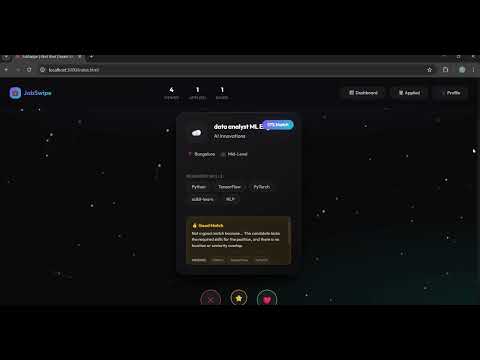
The video above demonstrates the complete end-to-end flow of JobSwap:
- Real-Time Job Ingestion: Aggregating live job data from multiple remote platforms (RemoteOK, Remotive, etc.) into a unified schema.
- Intelligent Scoring: The ML engine (
LogisticMatchScorer) analyzes the candidate's profile against job requirements to predict a match probability. - AI-Powered Insights: An LLM generates a clear, explainable "Why" for every match, highlighting specific skill overlaps or gaps.
- Interactive Interface: A responsive, card-swiping UI that allows users to seamlessly save or skip opportunities based on data-driven recommendations.
git clone https://github.com/blexyyyyy/jobswap.git
cd jobswap
pip install -r requirements.txt

# Run basic verification
pytest tests/

# Start backend
python app/main.pyThe system features a unified scraping architecture that collects and normalizes data from multiple platforms, including Remotive, RemoteOK, and Jobicy, ensuring a consistent schema across disparate data sources.
Matches are calculated using a hybrid approach:
- Logistic Regression: Predicts match probability based on historical user behavior and profile features.
- Skill Overlap Analysis: Quantitative assessment of candidate technical stacks against job requirements.
Utilizes the Gemini Pro and Ollama-based models to generate high-fidelity explanations for match results. This addresses the "black box" problem of automated matching by providing candidates with actionable career feedback.
A structured parsing engine extracts technical competencies, professional experience, and contact metadata from unstructured PDF and DOCX documents to automate profile generation.
A high-performance frontend implementation utilizing card-stacking logic for efficient candidate-job interactions, with persistence layers for saves, skips, and applications.
graph TD
    A[External Job Sources] --> B[Unified Scraper]
    B --> C[Data Normalization Pipeline]
    C --> D[(SQLite Database)]
    D --> E[FastAPI Backend]
    E --> F[ML Matching Engine]
    E --> G[LLM Insight Generator]
    F --> H[API Results]
    G --> H
    H --> I[Vite Frontend]
    I --> J[User Interactions]
    J --> D
- SOLID and Clean Architecture: Clear separation between high-level business rules (Services) and low-level implementations (Database/Scrapers).
- Dependency Inversion: Utilization of abstractions for LLM providers (Gemini, Ollama, Groq) and data sources.
- Deterministic Match Logic: Ensuring that AI insights align with underlying ML scores.
- Observability: Comprehensive logging and test-driven verification for every stage of the ingestion and matching pipeline.
- FastAPI: Asynchronous API layer for low-latency job delivery and profile management.
- Service Layer Pattern: Business logic isolated in dedicated service classes for high testability.
- JWT Security: Secure session management with strict authentication boundaries.
- ML Scorer: Feature engineering and logistic regression models for predicting user preferences.
- Explanation Generator: Strategic prompt engineering for contextual match analysis.
- Vector Base (Ready): Architecture designed to support semantic search via ChromaDB integration.
- Vanilla JavaScript (ES6+): High-performance, low-dependency code structure.
- CSS3 Design System: Glassmorphism aesthetics with modular stylesheets for consistent UI/UX.
- Responsive Animations: Optimized 60fps gesture-based interactions.
- Ingestion: Scrapers fetch raw job data; the pipeline cleans and persists it to the database.
- Profiling: Users upload resumes; the parser extracts data to build a structured profile.
- Discovery: The API generates a job feed; the ML engine scores each job against the user profile.
- Analysis: On-demand AI insights provide the "Why" behind the match score.
- Action: User swipes are recorded; applications are tracked in the dashboard.
- Python 3.10 or higher
- Node.js (for frontend build)
- API Keys: Gemini Pro (optional but recommended for insights)
- Clone the repository and navigate to the root directory.
- Create and activate a virtual environment:
python -m venv .venv
.venv\Scripts\activate  # Windows
source .venv/bin/activate  # Unix
- Install dependencies:
pip install -r requirements.txt
- Configure environment variables in a
.envfile:GEMINI_API_KEY=your_key_here JWT_SECRET=your_secret_key
- Start the FastAPI server (Database initializes automatically):
python -m uvicorn app.main:app --reload
- Access the application via
http://localhost:8000/frontend/index.html.
The system includes a suite of verification scripts to ensure component integrity:
- Unit & Integration Tests:
pytest tests/ - Scraper Verification:
pytest tests/test_scrapers.py
When running the full test suite on Windows, you may encounter asyncio event loop errors (e.g., RuntimeError: Event loop is closed) due to known pytest-asyncio + ProactorEventLoop limitations. This does not affect CI (Linux) or production behavior. The conftest.py includes a workaround, but isolation issues may persist locally.
- Core Engine: Stable
- Matching Pipeline: Fully Integrated
- Auth System: Production Ready
- Frontend: Functional (Vite build ready)
- Planned: Persistent vector search refinement and automated application delivery.
MIT