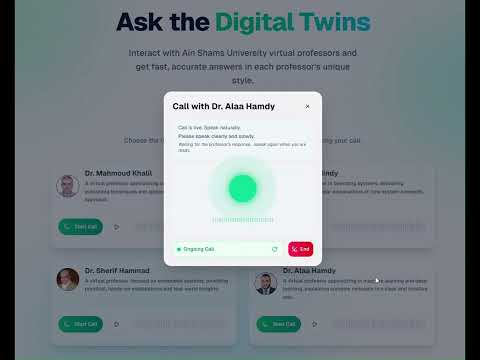
Welcome to the Conversational Professor Clone project! This repository contains the complete pipeline for generating a digital twin of a professor, enabling real-time voice-to-voice bidirectional conversations. The project covers automated data preprocessing, model fine-tuning, and a low-latency asynchronous deployment architecture over WebSockets.
- Pipeline Architecture Overview
- Preprocessing
- Training
- Deployment
- Monitoring
- Quickstart & Usage Guide

In the preprocessing phase, we scrape a lecture from each professor and process it through an automated pipeline to create 10-30 second clips with minimal human intervention.
-
Transcription & Alignment: The entire lecture
.mp3is sent into our ASR model (Qwen3 1.7b ASR) coupled with a forced aligner. This yields the exact start and end timestamp for each word. -
Smart Partitioning: Our partition algorithm slices the audio based on the end of words and phrases. This ensures clean clips without any trailing words cut off at the beginning or end, while maintaining context and consistency.
-
Evaluation: We utilize a small internal tool for rapid human evaluation and correction.
-
Dataset: The processed audio segments can be found at the ASU Professors Voice Cloning Dataset.

The training step involves fine-tuning the VoxCPM 2 model using LoRA configs to capture the nuance, tone, and speaking style of the professor. We use the clean segments from the preprocessing pipeline to train lightweight LoRA adapters on A100 gpu instance, for efficiency and fast iteration.
The deployment setup is designed for low latency and full-duplex communication using WebSockets.We modified the nanovLLM repository to support low-latency websocket streaming for both incoming audio and generated speech responses. Both the ASR and TTS backend servers are hosted on a single RTX A6000 on Thunder Compute.
- Qwen3 1.7b ASR is served using vLLM for highly optimized transcription.
- VoxCPM 2 is deployed via a self-modified version of nano-vllm that supports WebSocket integration. This hosts the base model and the dynamically loaded trained LoRA weights.
- Client-side VAD for interrupt detection enabling full duplex interaction
- Frontend deployment is powered by Cloudflare Pages.
The pipeline operates entirely asynchronously. Audio chunks are streamed from the client directly through the ASR inference, fed to the LLM, and synthesized by VoxCPM immediately to return output chunks to the client.

WS /stream: Primary full-duplex endpoint for client-server bidirectional communication. Handles incoming audio bytes and returns synthesized audio bytes and metadata.POST /loras: Dynamically load or swap LoRA adapters into the TTS pipeline without restarting the server.GET /health: Basic health check validation for the container orchestration and load balancing.
Server metrics are gathered from endpoint instrumentation using Prometheus and visualized in Grafana. This provides deep observability into system usage, latency percentiles, WebSocket connection health, and GPU metrics for the RTX A6000.
Below is the setup and startup sequence tailored for an Ubuntu VM on Thunder Compute.
Using uv, install the required libraries in both the root directory and the deployment directory:
# In the root directory
uv sync

# In the deployment directory
cd deployment
uv syncRun the ASR module from the root virtual environment:
vllm serve --config qwen3_asr_vllm.yamlActivate the environment variables and run the deployment app:
set -a
source deployment/.env
set +a

uv run fastapi run deployment/app/main.py --host 0.0.0.0 --port 8001Once the server is running, load your trained professor twin weights via curl:
curl -X POST http://localhost:8001/loras \
  -H "Content-Type: application/json" \
-d '{"name":"my_lora","path":"/home/ubuntu/latest"}'To benchmark the deployment and test concurrency under load, use the stress testing script provided in the root directory:
python stress_test.py