
A single-user reading room for one curated Calibre library, built on calibre-web.
A carrel is a private desk in a library. That is the design brief: no accounts, no sharing, no dashboard. One reader, 7,000 books, and an interface that gets out of the way.
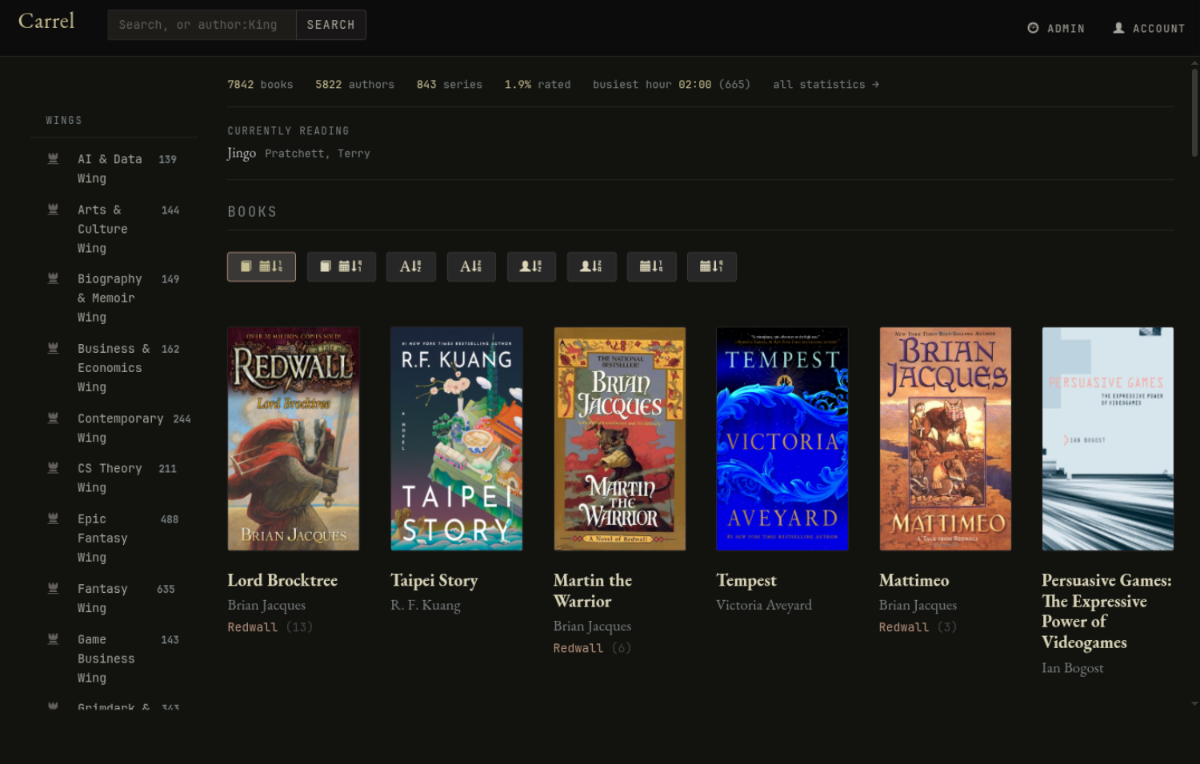
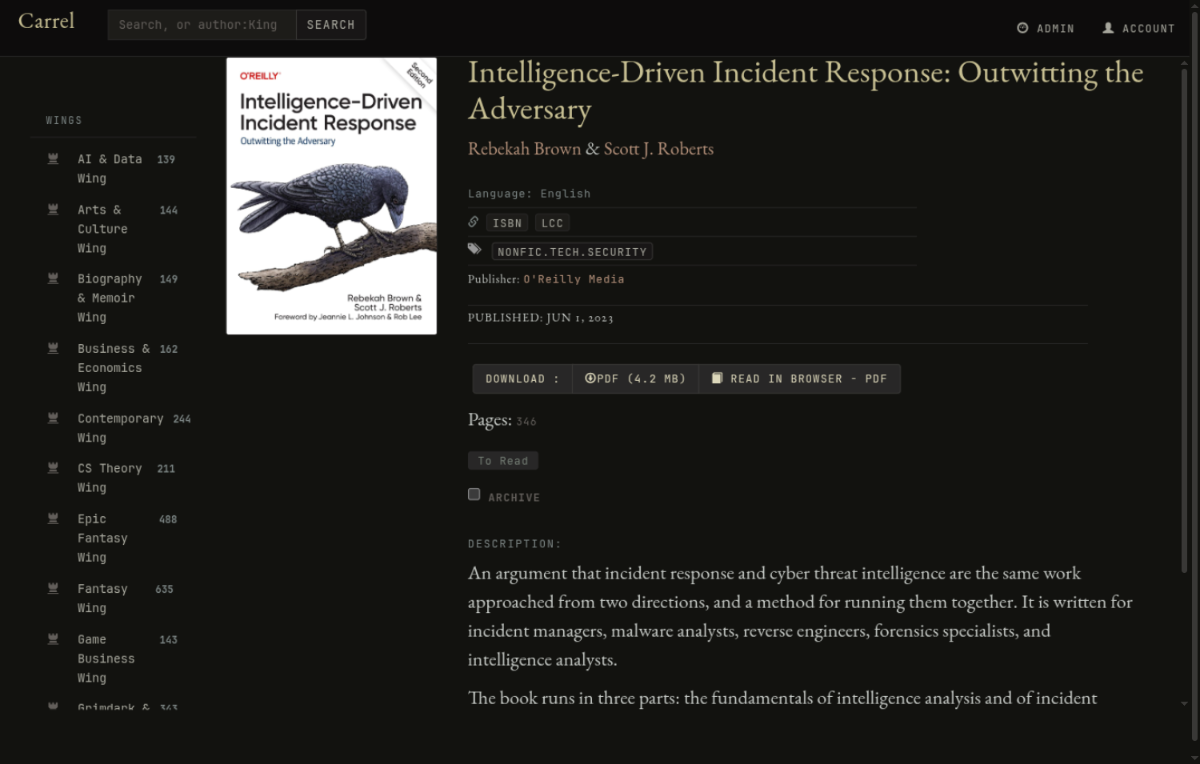
The register is a dark reading room wired into a terminal. Prose, titles and book metadata are set in a serif; every label, count, nav item and table header is mono. Surfaces stay in near-black so the covers are the most saturated thing on any page, and rows share hairline rules instead of floating as cards.
This repo is the contract and the theme. spec.md is authoritative:
read it before changing semantics. theme/kanagawa-dragon.css is the canonical
stylesheet, vendored into the fork by just sync-theme.
The code lives in the fork,
Carrel-calibre-web, on the
smallscope branch cut from calibre-web 0.6.26. Its README has the
screenshots and the feature tour.
- No login. The owner is authenticated on every request, so upstream's
login decorators pass untouched and rebases stay clean. (The family is
@login_required_if_no_ano: 39 across 5 modules at the 0.6.26 base, 42 across 10 at HEAD counting the fork's own five;admin.py's 94 route protections ride upstream wrapper decorators, satisfied the same way.) - Calibre's search grammar. Upstream has none; it matches the query as
literal FTS text, so
author:"King"returned nothing. Carrel evaluates through cquarry's stdlib port of Calibre's parser: field prefixes, boolean logic, grouping, hierarchical tags, custom columns (#audience:Rin) andvl:references. - Wings. Calibre virtual libraries as browse sections, evaluated through
that same engine, so the sidebar and a
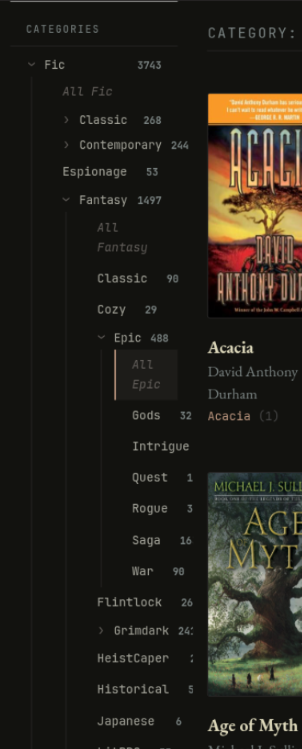
vl:search agree by construction. - A category browser over the library's dot taxonomy, where intermediate nodes are synthesised from path prefixes because only leaves are assigned.
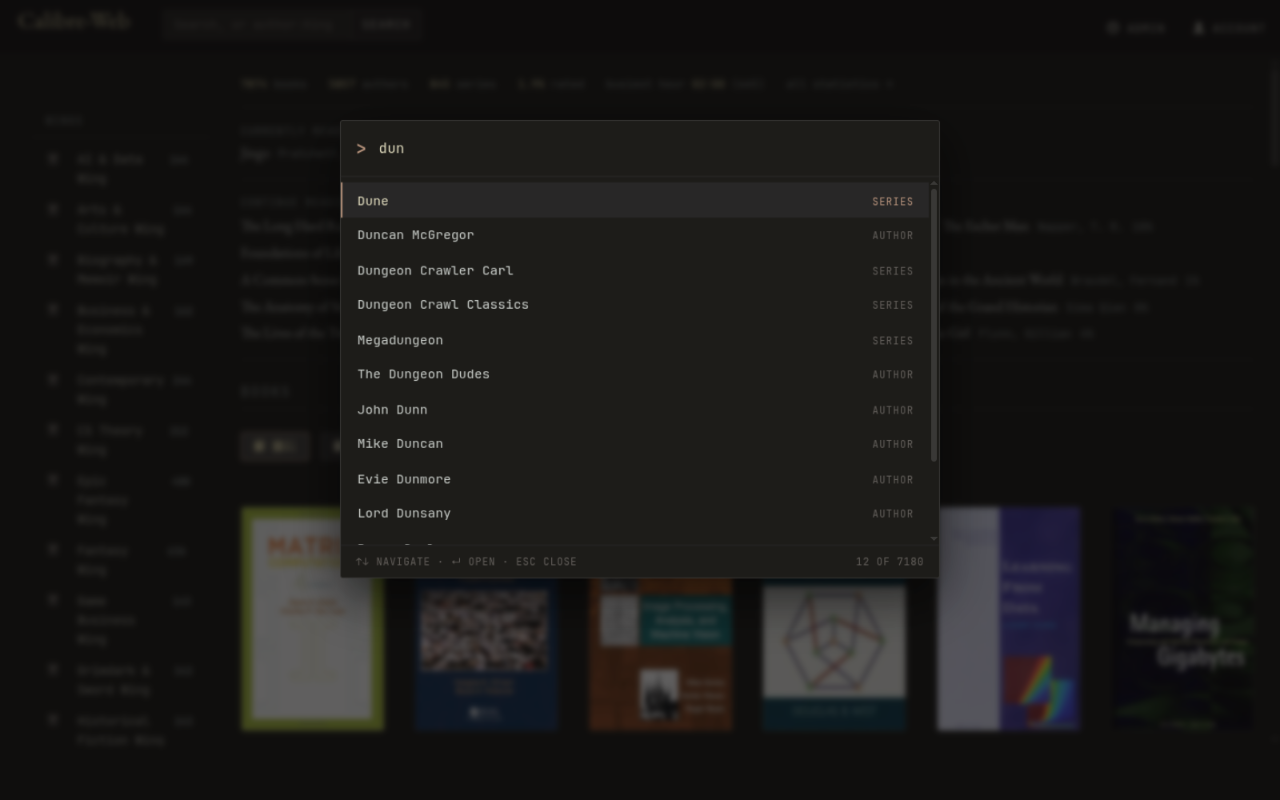
- Ctrl-K over every wing, author, series, category and page, falling through to a search when what you typed is not a destination.
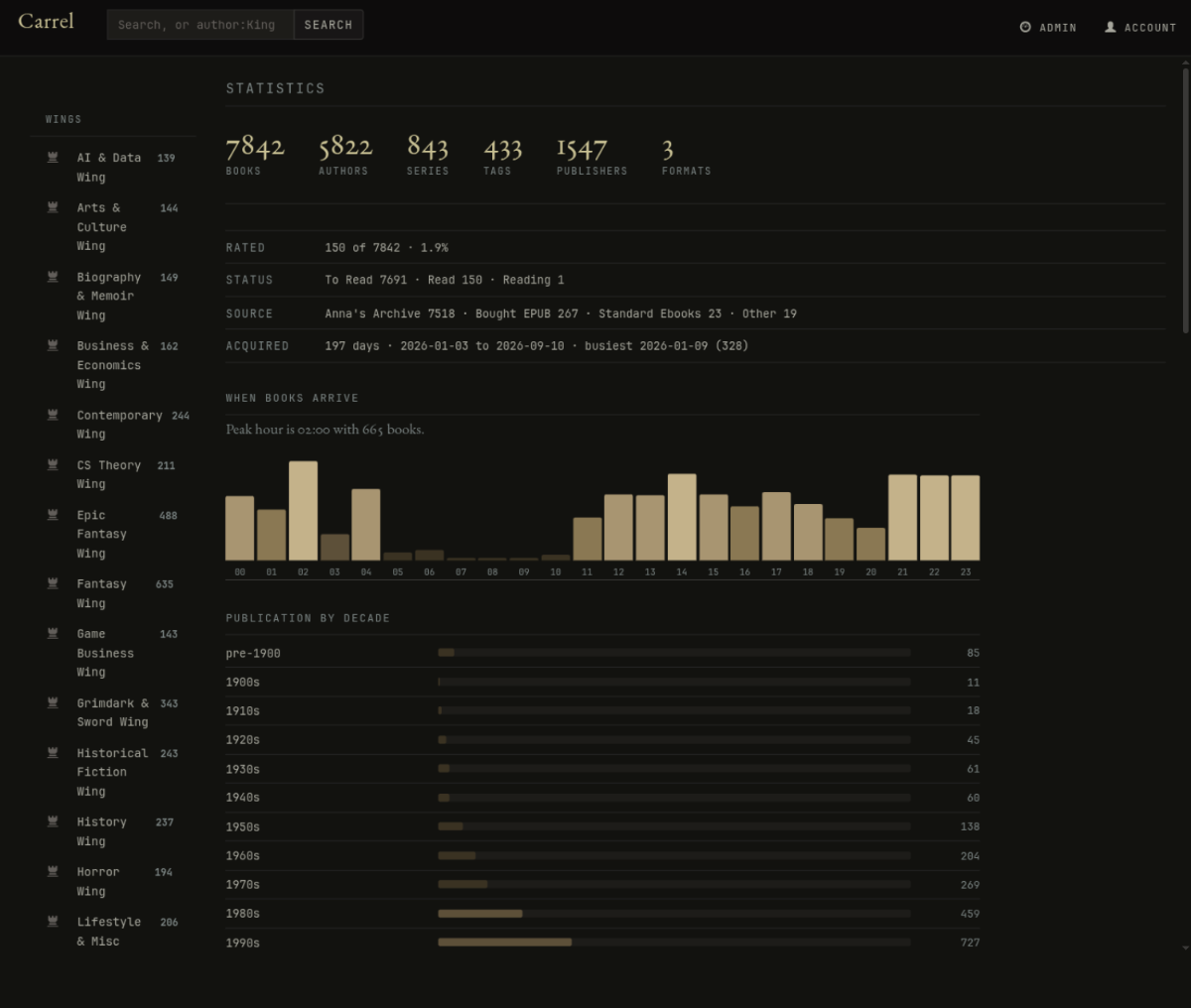
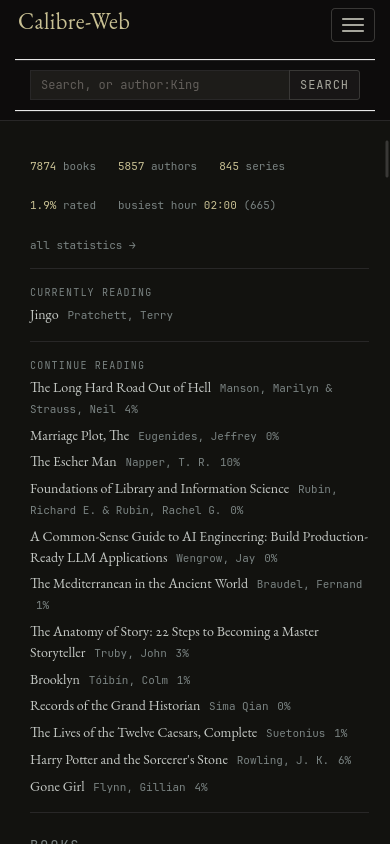
- Statistics computed live, where axes with a real distribution get charts and degenerate ones get a readout line.
- Read status from the library, read-only. An enumeration column (To Read / Reading / Read / DNF) rendered as a badge and never written back; status belongs to the curation workflow, not the web app.
- A read-only guarantee.
metadata.dbis attachedmode=ro. The web app cannot corrupt the library, by construction, and the tests prove it: the attach shows up inPRAGMA database_list, and anUPDATEthrough the session raises.
The palette is Kanagawa Dragon, from Brandon's Emacs port, which is the source of truth for the hexes. The structure is adapted from his Athenaeum static site so the two read as one property.
One constraint shaped the statistics surfaces more than any taste decision: Kanagawa fails as a categorical chart palette. Measured in OKLab against the dark surface, the worst adjacent accent pair sits at ΔE 6.7 for normal vision, before colour blindness is considered, and five of six accents fall below the chroma floor. So magnitude rides a single sequential gold ramp and identity is carried by position and a direct label. There is no categorical colour anywhere. See spec §4.3.
just check        # the theme contract: palette closure, serif stack, no caliBlur
just check-theme  # is the fork's vendored copy still the canonical one?
just sync-theme   # vendor theme/kanagawa-dragon.css into the fork
just sync-logo    # cut the fork's icon.svg/icon.png/favicon.ico from logo.svg
just serve        # run the fork from source
just test         # the fork's suite
The deployment venv is ~/.local/share/carrel/venv/; the calibreweb wheel is
uninstalled and the fork runs from source, because the 0.6.26 tree has no
src/ layout and cannot be installed editable.
There is no authentication. The bind address is the only thing standing between the library and the network, and it is currently
0.0.0.0deliberately. See spec §11.3 before changing where this runs.
CI guards the theme's contract rather than running application code (there is
none): it runs scripts/check-theme.py, the same file just check runs,
whose docstring is the authoritative list. It pins the 31-hex palette across
the stylesheet and the logo, refuses rgb()/hsl()/named-colour and modern
functional notations, pins both font-stack leads, forbids caliBlur selectors,
runs structural sanity (braces, var() resolution, raw-hex refusal), and
self-tests the guard itself. CI checks the fork out beside this repo, so the
icon byte-diff runs there too (Carrel CI reddening on fork icon drift is the
designed signal); the rendered icon.png/favicon.ico pair additionally needs
rsvg-convert and magick, so that last check is a local just check one.
Served from the fork's smallscope branch, so this README and the fork are
coupled by design: the images are the fork's, the contract is here.
 |
 |
 |
 |
v0.9.10. Phases 0 through 13 are complete. roadmap.md tracks what remains
before 1.0: the sign-off boxes and opportunistic items. patchnotes.md has
the history, newest first.
GPL-3.0, matching calibre-web. See LICENSE.
If this is useful to you and you would like to chip in:
- liberapay · liberapay.com/bdkl
- bitcoin
bc1qkge6zr45tzqfwfmvma2ylumt6mg7wlwmhr05yv