
This effort is supported by Qollab & IonQ.
Watch quantum error correction work, and hear it. Two logical qubits, each protected by a Steane [[7,1,3]] code, go through repeated rounds of error correction. Every parity-check readout is a cell in a grid (one row per round, one column per check), and each logical qubit is drawn as a triangle: 7 corners are data qubits, 3 faces are parity checks. Noise lights checks up, every lit check plays a note, and two decoders (plain belief propagation, BP, and Relay-BP) try to undo the damage.
Built for the Qollab × IonQ Global Quantum Hackathon, Oct 9–11 2026. An independent project. All product names belong to their owners.
- On Qollab, pick a backend in Select QPU and press Run:
- the built-in Qiskit simulator for the full experiment (up to 5 rounds, injected noise, exact ground truth), or
- IonQ Forte 1 (29q) Noise model for the IonQ mode: one round on 26 qubits under IonQ's own noise (see IonQ mode). Aria 1 (25q) is too small and shows a message.
- Pick a logical circuit, a noise channel, the strength
p, the rounds and the readout basis, then press Run in the page. - The grid plays one shot at a time. Read the How to read this box at the top of the page, or go to the documentation (12 short chapters with diagrams and something to try in each).
Turn p up, listen to the music get denser, then watch BP fail before Relay-BP does. Use 192–256 shots to see the gap through the noise.
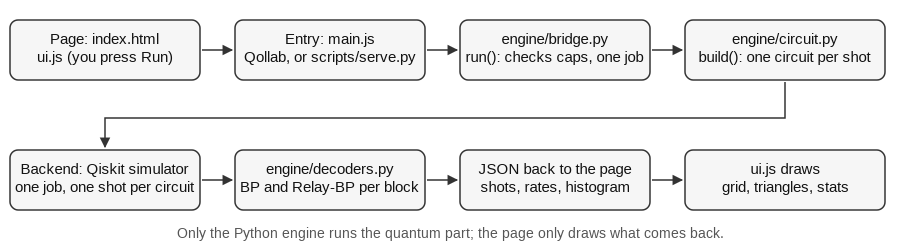
How one Run travels through the code (the shot flow is in chapter 4):
- Qubits. Two Steane blocks need 14 data qubits. One ancilla is measured and reset after every check, so the circuit fits in 15 qubits for any number of rounds. (The IonQ mode uses 26, see below.)
- Circuit (
engine/circuit.py). Logical gates, encoding, rounds of checks, final readout. Every shot is its own circuit, sent in one job. - Noise (
engine/noise.py). Bit flip, depolarizing and SI1000 (circuit-level). Noise is sampled per shot and inserted as explicit Pauli gates. - Ground truth. A Pauli frame (a record of the injected errors) is tracked through every gate, so each shot is judged exactly, not by a decoder.
- Decoders (
engine/decoders.py). BP and Relay-BP work on a space-time check matrix, in plain numpy. The limit is the exact error rate of the best decoder that reads one error type at a time.
For the reasoning behind each part, read the docs: syndromes, noise models, decoders, limits.
Qollab's IonQ route has no mid-circuit measurement or reset, takes one circuit per job, and IonQ jobs must be sent while main.js is still running. So on an IonQ backend the engine switches mode (_mode in engine/bridge.py):
| Built-in simulator | IonQ mode | |
|---|---|---|
| Rounds | 1–5 | 1 |
| Ancillas | one (q14), measured and reset after each check | a fresh one per check (q14–q25), all measured at the end |
| Qubits | 15 | 26 (fits Forte 1, 29q; not Aria 1, 25q) |
| Noise | injected Paulis (channel, p) |
IonQ's noise model; channel and p only set the decoders' prior |
| Job | one circuit per shot | one circuit, many shots |
| Ground truth | Pauli frame, exact per shot | ideal outcomes: a logical error is a decoded outcome the ideal never gives (outside 00 / 11 for the Bell pair) |
Judging against the ideal misses errors that land on an allowed outcome, so it is a lower bound, and it counts nothing when the ideal allows all four outcomes (the page then shows only the histograms). There is no optimal-decoder limit in this mode. main.js waits for the first in-page Run before it finishes, as in the Waiting for user input section of Qollab's JS / Qiskit docs. So each Qollab Run sends one IonQ job: after it the page's Run button is disabled. Press Qollab's Run again for another job, or use the built-in simulator for multiple runs.
- Repeated rounds only on the built-in simulator. They need mid-circuit measurement and reset on one reused ancilla; on IonQ the page runs the one-round mode above. Without the reuse, more rounds would need 12 more qubits each.
- Simulation is a full statevector, shot by shot. Rounds (max 5), shots (max 256) and
p(0 to 0.1) are capped. - Logical gates act before encoding only. Gates between rounds would need the decoders to track errors moving between blocks.
- For SI1000 no optimal-decoder limit is shown, because the decoders use only a rough model of that noise.
pip install -r requirements.txt
python scripts/serve.py          # http://localhost:8000, optional port as argument
python scripts/serve.py --ionq   # the IonQ mode on a local stand-in for IonQ's noise simulator (needs qiskit-aer)
python -m engine.selfcheck       # the engine's assertions (IonQ-mode checks need qiskit-aer)
python scripts/benchmark.py      # the decoder table in docs chapter 9 (fixed seed)
scripts/serve.py serves the same page and sends Run to a local /run endpoint, where native Python runs engine.bridge.run on the same simulator. The docs load KaTeX from a CDN, so the maths needs an internet connection. Opening index.html directly does not work, because engine.bridge only exists inside Qollab.
The circuit figures in src/img/ are drawn from the code: python scripts/make_diagrams.py (needs matplotlib: pip install -r requirements-dev.txt).
index.html, main.js     Qollab entry points (stay at the root; main.js imports engine.bridge and passes `backend`)
main.css                generated from src/css by scripts/build_css.py (Qollab only loads a root main.css)
requirements.txt        qiskit, numpy
engine/                 Python: steane, noise, circuit, decoders, bridge, selfcheck
src/js/                 ui.js, audio.js (app), steane-patterns.js (docs)
src/css/                tokens.css, main.css (app), docs.css (docs)
src/fonts/              Geist, Instrument Serif (+ licences)
src/docs/               the documentation (index.html, chapters, appendices)
src/img/                diagrams (SVG) used by the docs and README
scripts/                serve.py (local mode), benchmark.py (chapter 9 table), make_diagrams.py (figures), build_css.py (main.css)
- Relay-BP: T. Müller et al., Improved belief propagation is sufficient for real-time decoding of quantum memory, 2025, arXiv:2506.01779.
- SI1000: C. Gidney, M. Newman, A. Fowler, M. Broughton, A fault-tolerant honeycomb memory, Quantum 5, 605 (2021).
MIT licensed. Fonts (Geist, Instrument Serif) are under the SIL Open Font License 1.1; see src/fonts/NOTICE.md.