The Wireless House Wire Detection System is a DIY project designed to provide a non-intrusive solution for detecting live wires behind walls. This system utilizes an Arduino board, a Hall Effect sensor, LEDs, and optional components to enhance safety and efficiency during home improvement activities.
The House Wire Identification System aims to enhance safety measures during domestic tasks by providing a method to locate energized wires within walls. Key purposes include:
- Safety Enhancement: Minimize the risk of accidental electrical encounters during home improvement activities.
- Efficient Wire Tracing: Locate hidden wires without the need for physical access to walls, streamlining maintenance or refurbishing tasks.
- Preventing Accidental Breaches: Design to prevent unintended damage to wiring during wall modifications or drilling.
- User-Friendly Operation: Crafted to be intuitive and cable-free, suitable for homeowners and DIY enthusiasts.
- Arduino UNO R3
- Hall Effect/Magnetic Sensor
- Breadboard
- LED
- Buzzer
- Jumper Wires
- Power Cord or USB Type A to Type B cable
The system employs an Arduino and a Hall Effect sensor to detect the magnetic fields of live wires. The Arduino reads the sensor output, and if the values fall outside the standard range, LED indicators and a buzzer activate to alert users. The sensor state is displayed on the serial monitor or an optional LCD.
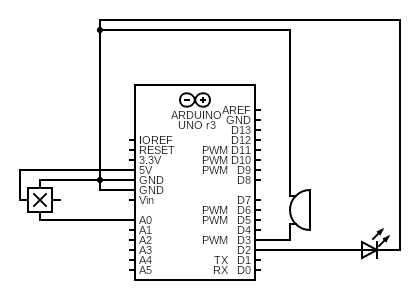
- Electromagnetic fields of live wires are weak, and simple Hall Effect Sensors may struggle to detect them.
- The hall effect sensor can only detect the presence or absence of a magnetic field, not its strength or direction.
- External magnetic interference can affect sensor readings.
- Limited range and sensitivity may vary based on wall material.
- The project requires a power source for the Arduino, which may not be convenient or portable.
- Use advanced hall effect sensors for more accurate readings.
- Integrate wireless modules (Bluetooth or Wi-Fi) for data transmission to smartphones or computers.
- Incorporate a battery or solar panel for self-sufficiency and mobility.
- Add a 3D printed case for better aesthetics and improved portability.
-
Suddhashil Sarkar
-
Subhajit Sarkar
-
Subham Mukherjee
-
Subhamay Kundu
-
Sulagna Mandal
-
Suparna Das
This project has been made under the supervision of Institute of Engineering and Management, Kolkata. Special thanks to the Faculty members and the team of IEM-Robotics for their guidance throughout this project.