

Diverse P&R benchmarks, distilled into one plug-and-play PyTorch environment on the GPU.
Evolve VLSI placement, timing-optimization and routing algorithms in minutes, not days.





Quick start · Why Attar · What's inside · How it works · Gallery
pip install attarimport attar
d = attar.load('after_fp/orfs_asap7/aes', device='cuda') # from the zoo, as tensors on the GPU
d.place() # or set d.pos from your own algorithm
print(attar.Evaluator(d).hpwl(), d.timing().wns) # HPWL, and WNS as OpenSTA reports it
d.export('aes.def') # back to OpenROAD, Innovus, ICC2, ...Designs download from the Attar zoo on first use. The first
timing run on a GPU compiles its kernels (about two minutes, once). No GPU? Everything also runs on the CPU, or try
the demo in Colab:

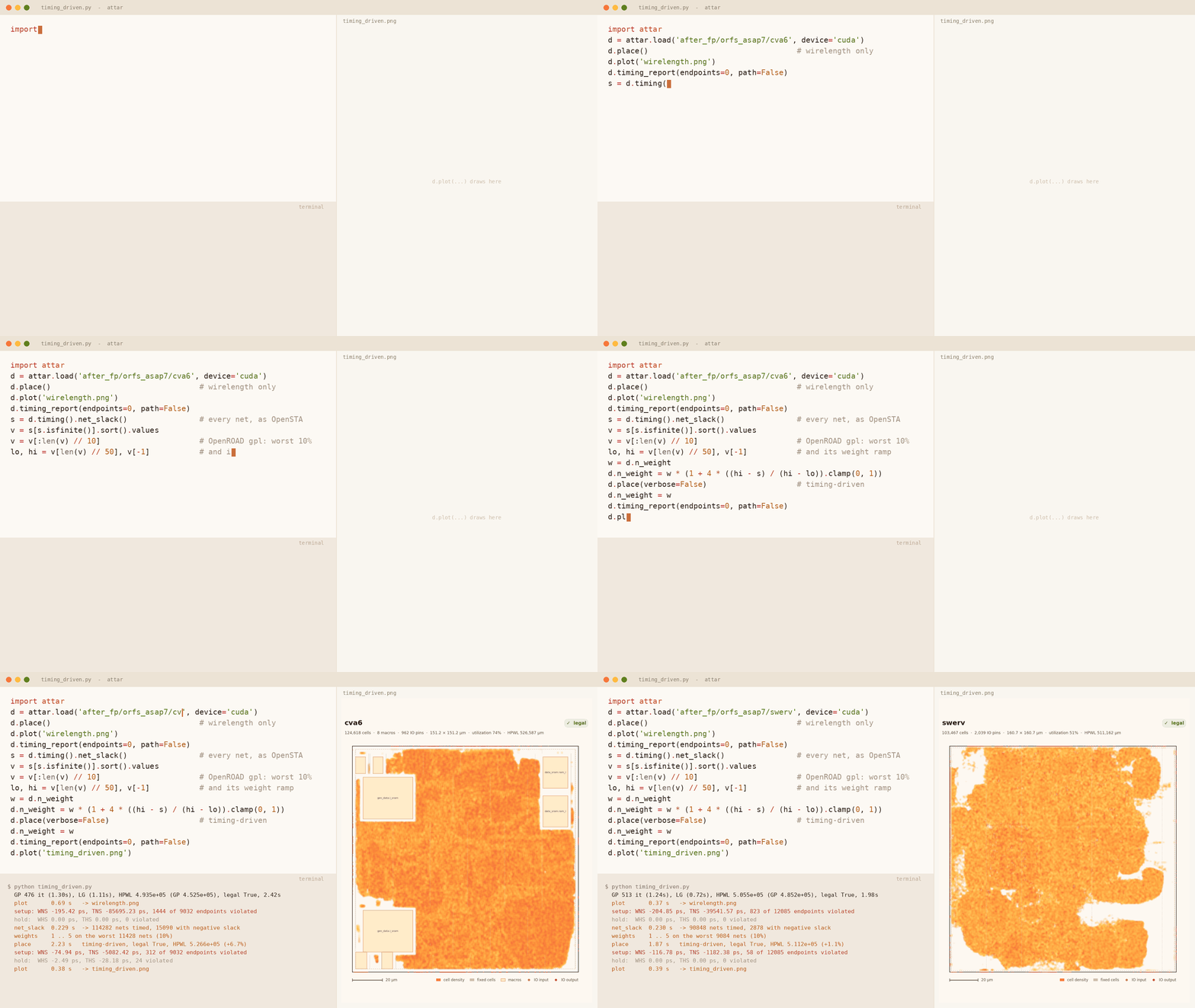
Timing-driven placement in 15 lines (examples/timing_driven.py): cva6 WNS -195 → -75 ps, in 2.2 s on an RTX 3080 Ti.
- Fast. Exact HPWL of 8.9M pins in 3 ms; a 2.2M-cell design placed and legalized in 49 s. An idea, from your code or an AI agent's, is tested in seconds, not in an overnight P&R run.
- One environment. 262 designs from 24 benchmark suites (ISPD 2005-2024, ICCAD 2015 and 2025, MCNC, GSRC, IBM-HB+, OpenROAD-flow-scripts) load with one call, in one format, from LEF/DEF, Bookshelf or YAL. An algorithm is a function from tensors to positions: no database API, no TCL.
- Faithful. Against OpenROAD and OpenSTA on the same placement: HPWL within 0.00002%, timing (WNS) within 0.34%, power within 0.06%, global-routing wirelength within 3.6%.
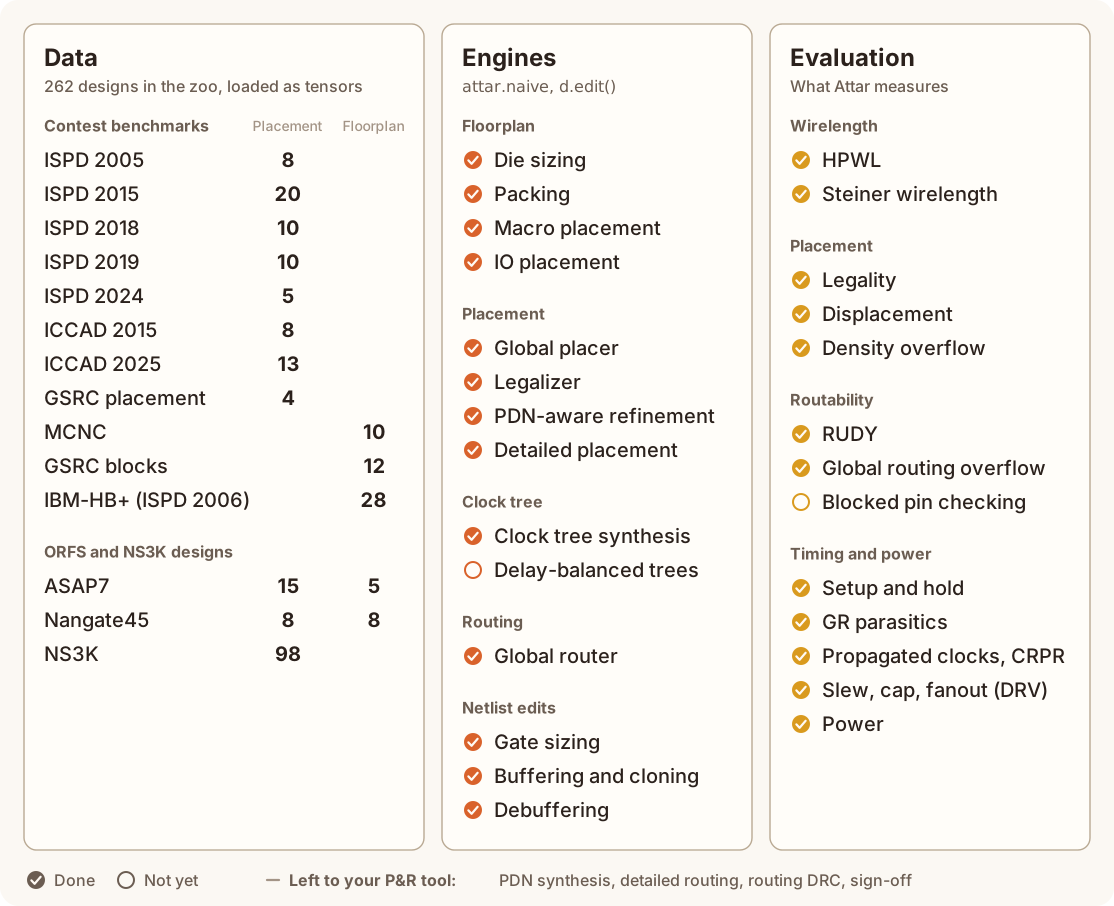
Every engine and evaluator, with its accuracy against OpenROAD and OpenSTA: docs/features.md.
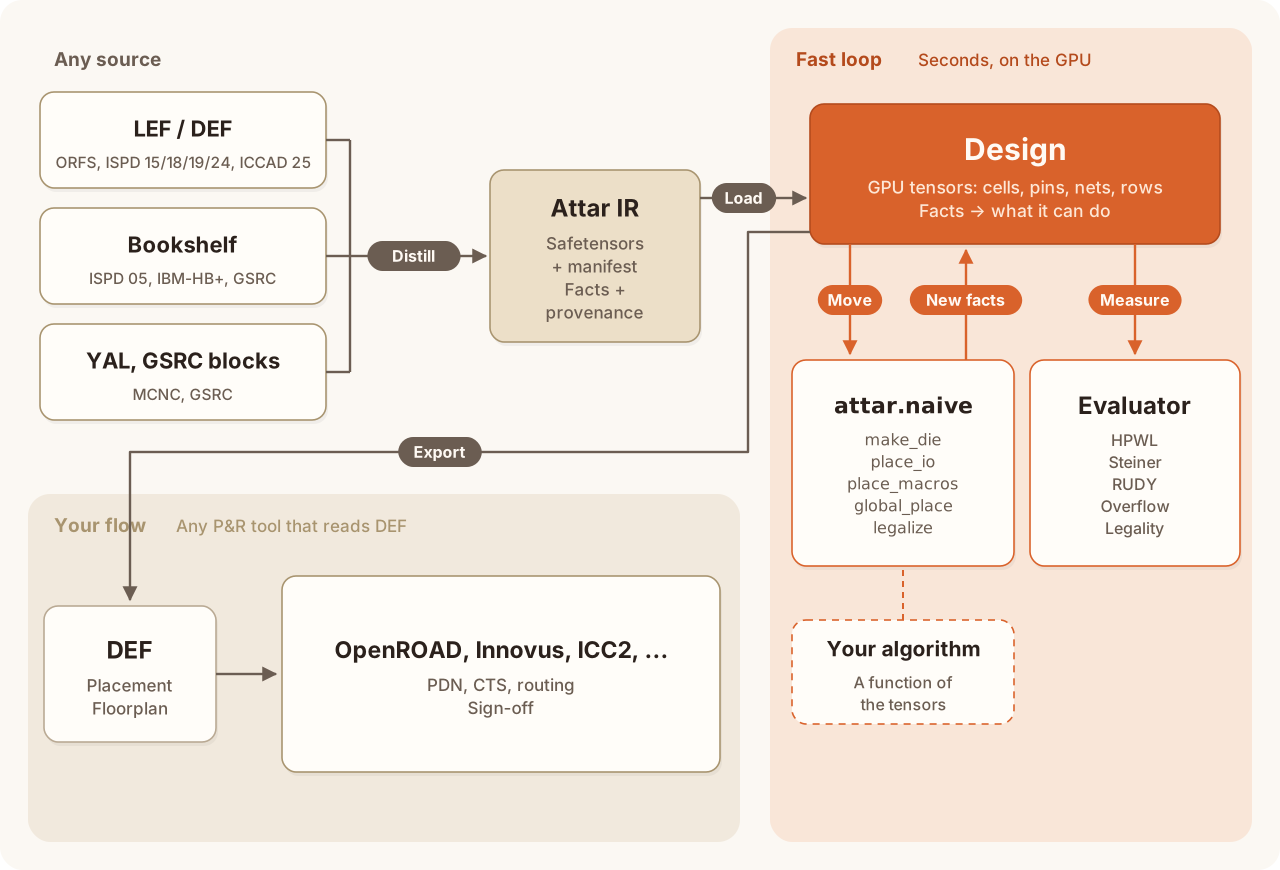
Attar splits physical design at the power grid, as production flows do:
before_fp: given a netlist, find the die, IO pins and macros (d.floorplan()).after_fp: given a fixed floorplan with its PDN, place the cells, then size, buffer, route and time them (d.place()).
Every design states the facts it has and where each came from, and every engine says which facts it needs:
>>> d.status()
  ✅ netlist           def             12268 nets, 42885 pins
  ✅ cell_geometry     lef             12420 cells (12009 movable, 0 macros), 56 masters
  ✅ pdn               def             1815 wire and 4785 via shapes on M1, M2, M3
  ...
  ❌ placement         12009 movable cells unplaced
  -> only a placement is missing: place the design, then d.export("out.def")
Docs: concepts · engines and evaluators · benchmarks · API · validation
 |
|
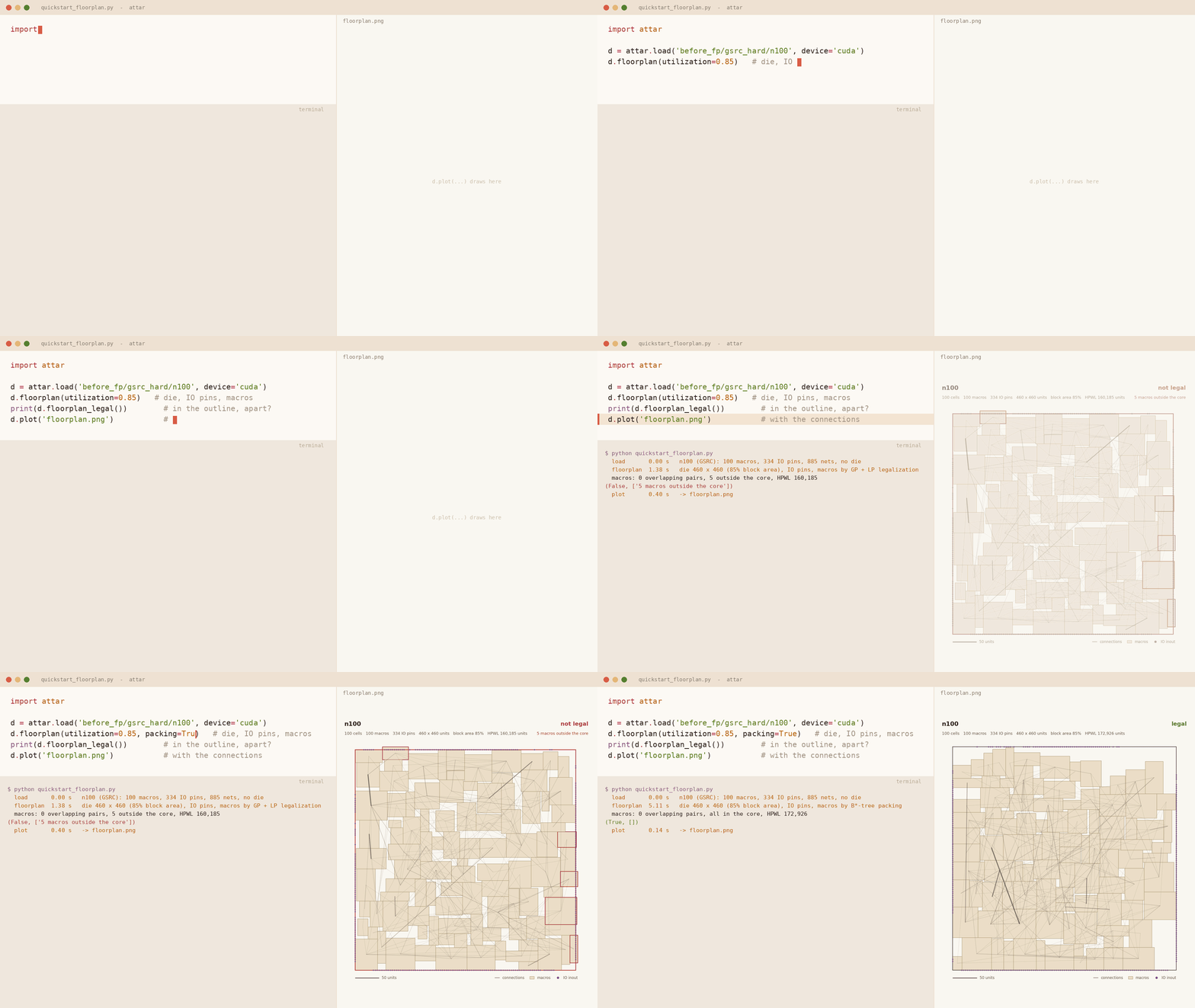
| Floorplanning GSRC n100: B*-tree packing fits all 100 blocks into the core in 5.1 s. | |
 |
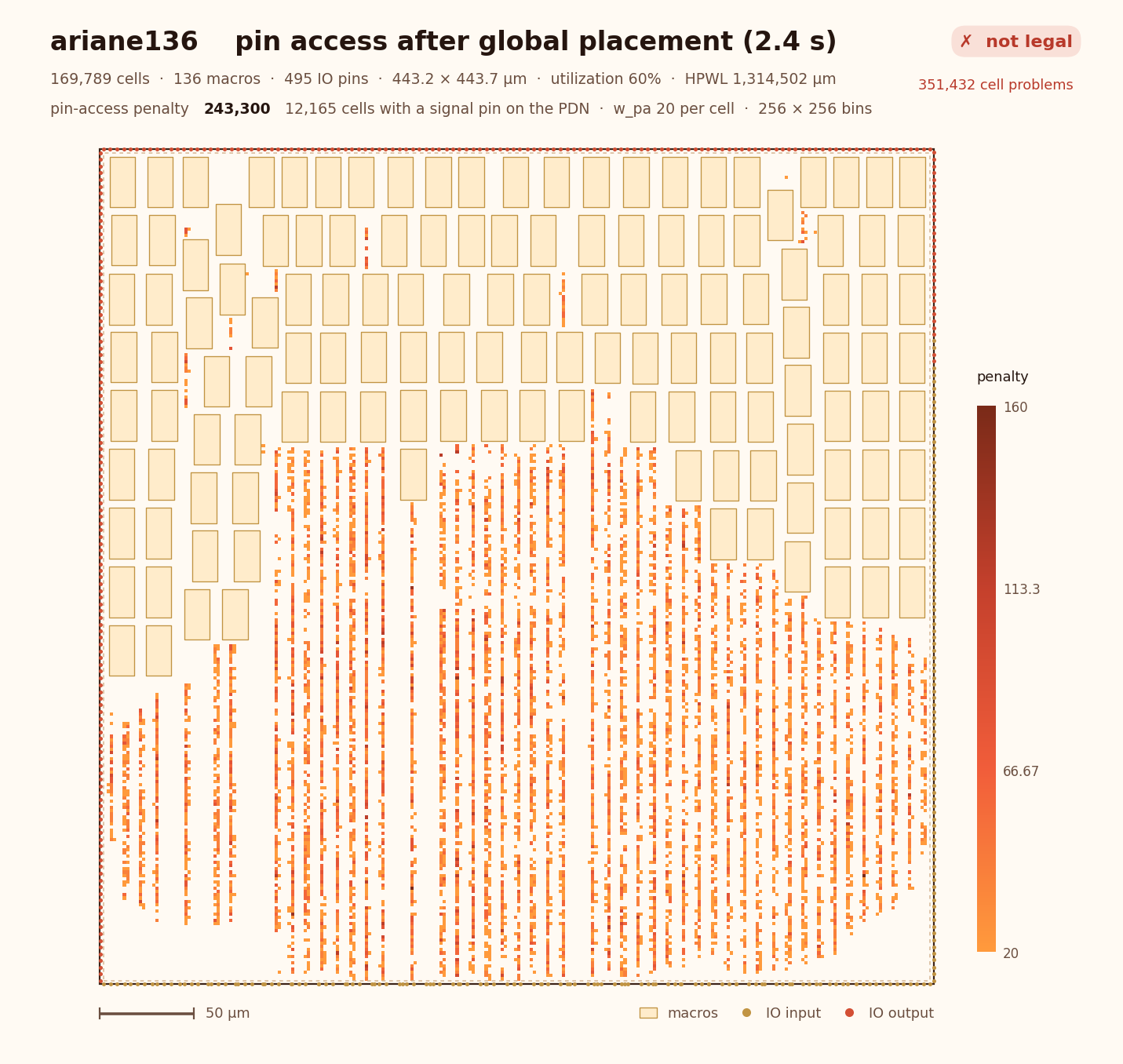 |
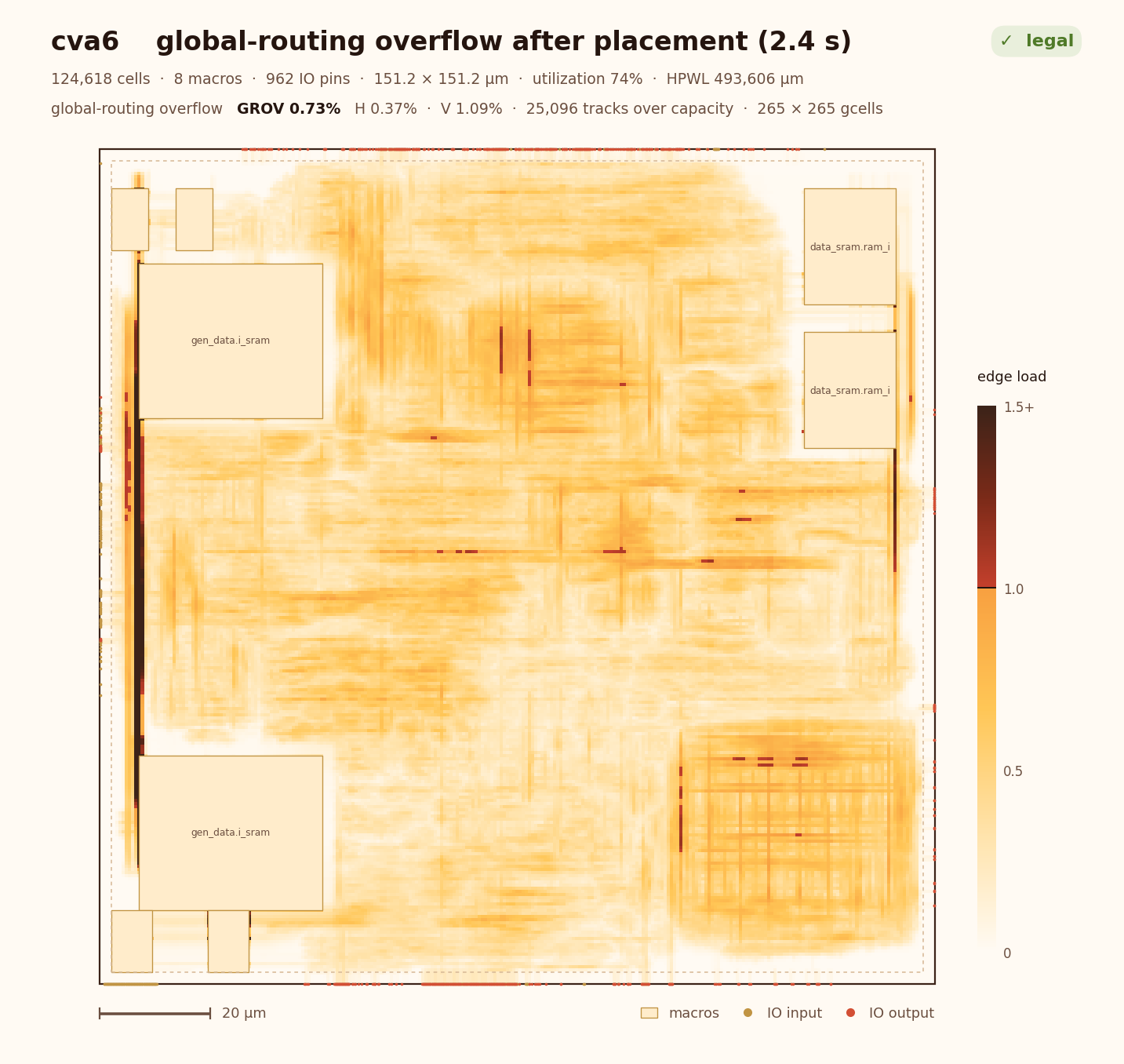
| Routing congestion cva6, placed in 2.4 s. | Pin access ariane136: cells with a signal pin on the PDN's vias. |
 |
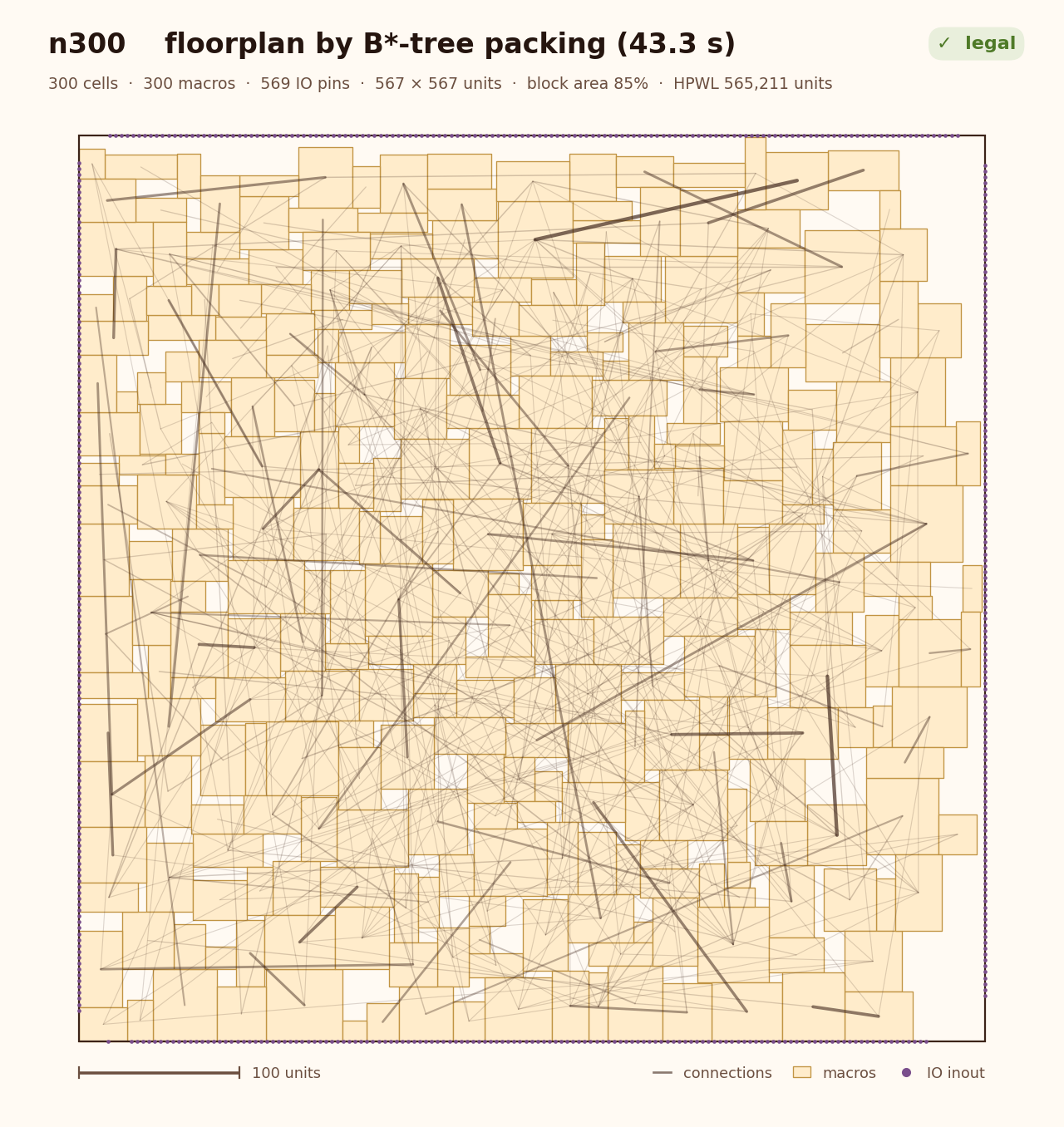 |
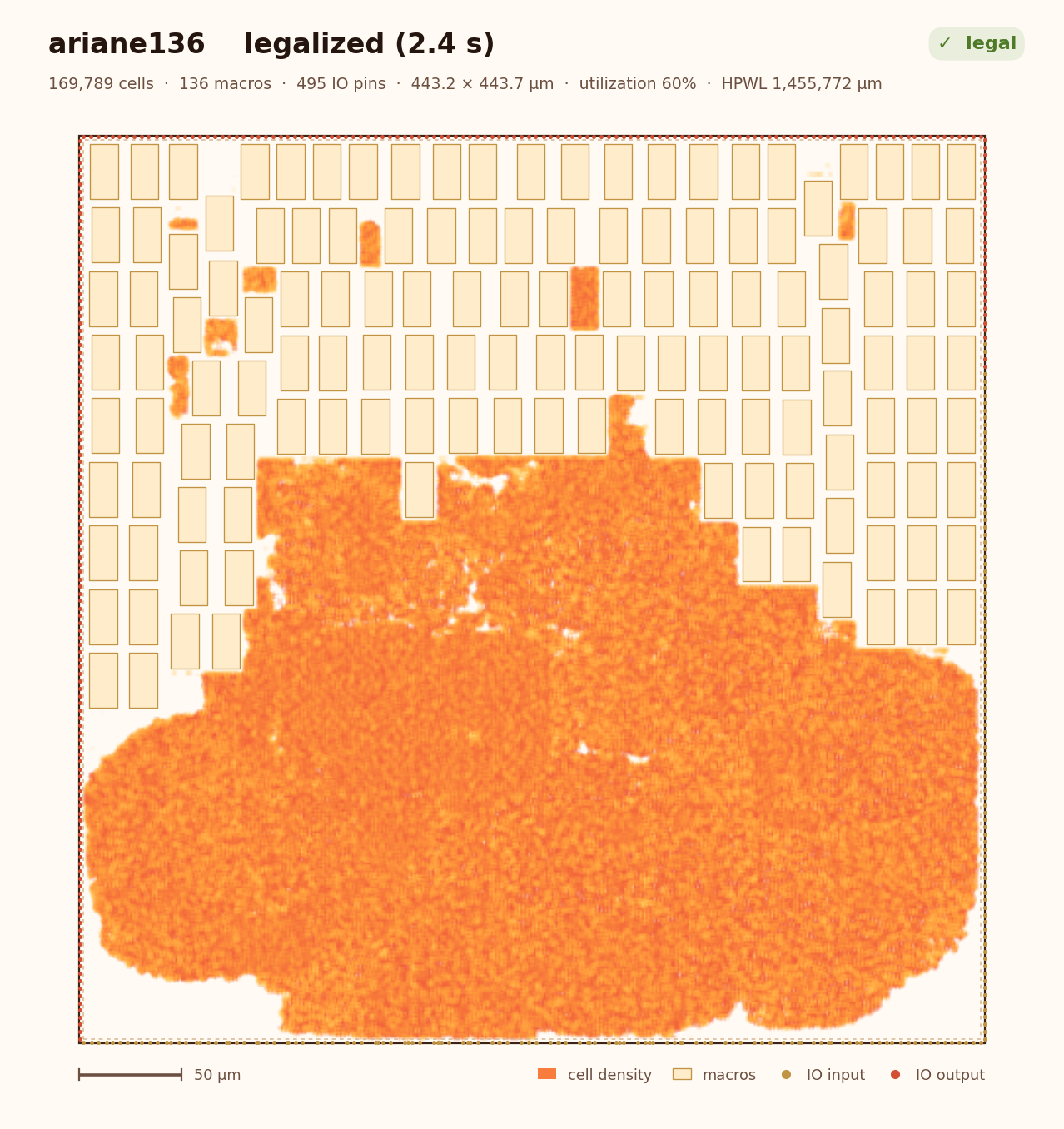
| Legal placement ariane136, rails and PDN included, in 2.4 s. | Floorplan GSRC n300: 300 blocks, 569 IO pins, packed in 43 s. |
Attar's placer follows ePlace, DREAMPlace and Xplace; its checks follow OpenROAD. It is validated against OpenROAD-flow-scripts on ASAP7 and Nangate45. Benchmarks are from the ISPD, ICCAD and GSRC contests, MCNC and ORFS.
