A Regulated MedTech System combining Deterministic Terminology Enforcement, Hybrid AI Translation, and Visual UI Constraint Validation.
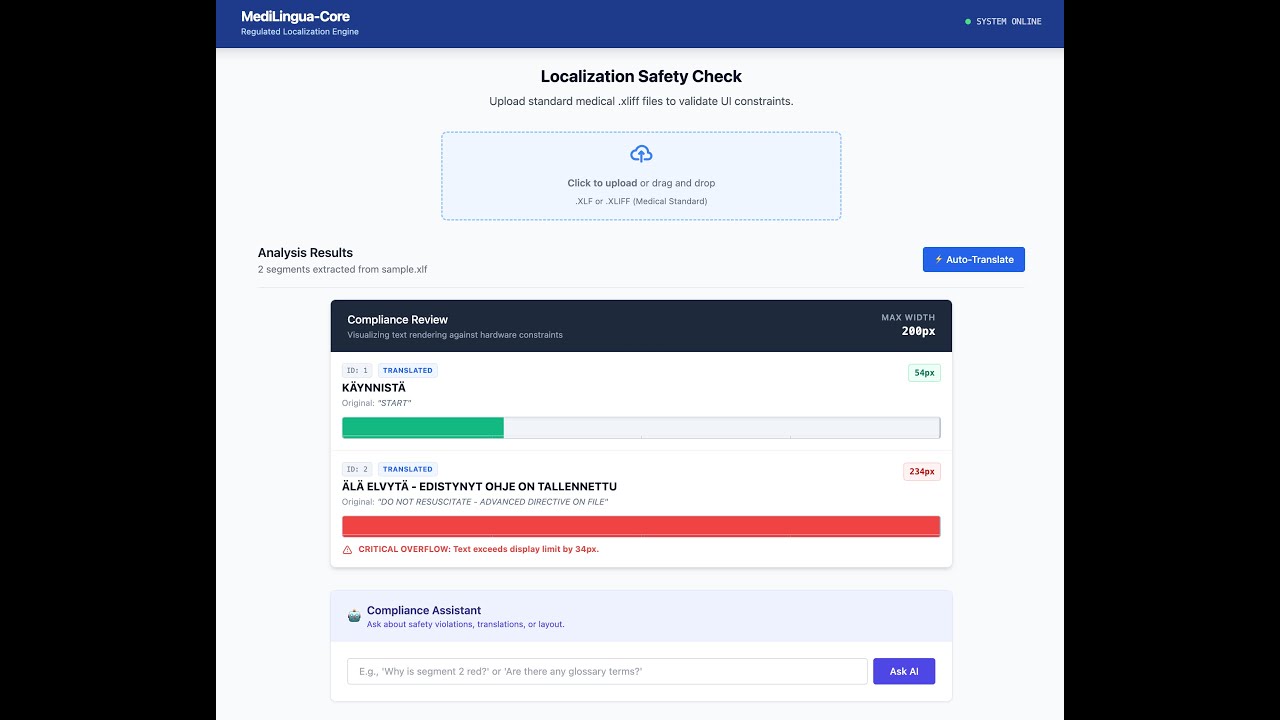
📺 Watch the Platform Demo featuring Pixel-Perfect Width Validation, Glossary Injection, and Context-Aware Auditing.
MediLingua-Core is a reference architecture for Safe Medical Software Localization. It bridges the gap between standard translation workflows and embedded device constraints. It features a deterministic safety glossary, a hybrid AI translation engine, and a "Pixel-Width Guardrail" that mathematically guarantees text fits on patient monitor screens before deployment.
In embedded medical devices, a translation error isn't just a typo—it's a patient safety risk. Standard translation tools (TMS) treat text as abstract strings, ignoring the physical constraints of the device screen, leading to critical "text overflow" where warnings like "DO NOT RESUSCITATE" get cut off.
| The Problem | MediLingua-Core Solution |
|---|---|
| Text Overflow | German translations often expand by 30%, cutting off critical UI text on fixed-width screens. |
| AI Hallucination | LLMs might creatively translate "Cardiac Arrest" instead of using the standard "Sydänpysähdys". |
| Format Fragility | Generic JSON parsers break strict medical XML/XLIFF 1.2 standards. |
| Audit Gaps | No record of why a specific translation was chosen or rejected. |
MediLingua implements a Safety-First Pipeline, utilizing containerized services for parsing, deterministic injection, AI augmentation, and visual rendering.
The Localization Lifecycle: Parse Inject Translate Validate Visualize.
graph LR
    subgraph "Frontend Layer (React)"
        UI[Review Dashboard] -- "Upload .XLF" --> API
        UI -- "Audit Chat" --> API
    end

    subgraph "Compliance Core (Python/FastAPI)"
        API[API Gateway] -- "Parse" --> LXML[XLIFF Parser]
        LXML -- "Extract" --> Gloss[Glossary Injector]
        Gloss -- "Safety Term?" --> Hybrid{Hybrid Engine}

        Hybrid -- "Yes (Deterministic)" --> Term[Safety Dictionary]
        Hybrid -- "No (Probabilistic)" --> LLM[OpenAI GPT-4o]

        Term --> Width[Pixel Guardrail]
        LLM --> Width

        Width -- "Render (Pillow)" --> Report[Analysis Report]
        Report -- "JSON Response" --> API
    end

    style LXML stroke:#00ADD8,stroke-width:2px
    style Gloss stroke:#F7931E,stroke-width:2px
    style Width stroke:#C72C48,stroke-width:2px
    style LLM stroke:#10A37F,stroke-width:2px
How the system prevents UI overflow using a Feedback Loop.
sequenceDiagram
    participant U as QA Engineer (UI)
    participant A as API (Backend)
    participant E as Engine (Logic)
    participant L as LLM (AI)

    U->>A: Upload "vitals.xlf"
    A->>E: Parse & Extract Source
    E-->>A: Return Source Widths
    A-->>U: Display Source Analysis

    U->>A: Click "Auto-Translate"
    A->>E: Check Safety Glossary
    alt Term Found
        E->>E: Inject "PYSÄYTÄ" (Stop)
    else Term Missing
        E->>L: Translate via GPT-4o
        L-->>E: Return Finnish Text
    end

    E->>E: Render Text (Roboto-Medium 16px)
    E->>E: Calculate Width (e.g., 234px)

    alt Width > 200px
        E-->>A: Status: CRITICAL OVERFLOW
    else Width <= 200px
        E-->>A: Status: SAFE
    end

    A-->>U: Display Red/Green Visual Indicators
Strategic engineering choices for a regulated environment.
| Component | Decision | Alternatives Considered | Justification (The "Why") |
|---|---|---|---|
| Parsing Engine | lxml (C-binding) | xml.etree / Regex | Correctness: Medical XLIFF files have complex namespaces. lxml is the only Python library robust enough to preserve XML structure for round-trip processing without data loss. |
| Rendering Engine | Pillow (PIL) | Browser Canvas / Estimation | Determinism: Browser rendering varies by OS. We calculate pixel width server-side using the exact font binary (Roboto-Medium.ttf) to guarantee the result matches the embedded device. |
| Translation Strategy | Hybrid (Glossary + LLM) | Pure LLM / Pure Dictionary | Safety: We cannot risk AI hallucination on safety labels (e.g., "STOP"). Hardcoded dictionary lookups always take precedence over probabilistic LLMs. |
| Infrastructure | Docker Compose | Kubernetes / Serverless | Reproducibility: A localized, containerized environment ensures the system behaves exactly the same on a developer's laptop as it does in the CI/CD pipeline, crucial for audit trails. |
The core differentiator. Instead of counting characters (which is inaccurate for variable-width fonts), the system:
- Loads the specific TrueType Font (
.ttf) used by the medical device. - Renders the translated string into an off-screen memory buffer.
- Measures the exact pixel usage.
- Flags any string exceeding the 200px hardware limit.
We implement a "Safety Sandwich" for translation:
- Layer 1 (Deterministic): Inputs are checked against a
SAFETY_GLOSSARY. If "DO NOT RESUSCITATE" matches, the approved translation is forced. - Layer 2 (Probabilistic): Only non-critical, fluent text is sent to
gpt-4o-mini. - Layer 3 (Contextual Audit): A RAG-lite chatbot analyzes the final state to explain why a specific segment failed (e.g., "Segment 2 failed because 'ÄLÄ ELVYTÄ...' is 234px, exceeding the 200px limit").
- Audit Trail: Every code change triggers a GitHub Action workflow.
- Parity: The CI pipeline runs tests inside the exact same Docker container as production (
docker-compose exec), ensuring no "works on my machine" discrepancies. - Strict Typing: Frontend (TypeScript) and Backend (Pydantic) share strict schemas to prevent data malformation.
| Layer | Technology | Role |
|---|---|---|
| Backend | Python 3.11 | Core logic runtime. |
| API | FastAPI | High-performance async REST endpoints. |
| Validation | Pydantic v2 | Strict data modeling and schema enforcement. |
| Parsing | LXML | Robust processing of .xliff 1.2 medical files. |
| Rendering | Pillow | Server-side text rendering for pixel calculation. |
| AI | LangChain + OpenAI | Orchestration of Hybrid Translation & Chat. |
| Frontend | React 18 + Vite | Interactive "Digital Twin" dashboard. |
| Styling | Tailwind CSS | Medical-grade UI clarity (high contrast alerts). |
| Testing | Pytest / Vitest | 100% coverage of parsing and width logic. |
- Docker Desktop (Engine 24+)
- Make (Standard on Linux/Mac, use Git Bash on Windows)
- OpenAI API Key (Required for AI Translation/Chat features)
Create a .env file in the root directory.
# Core Settings
PROJECT_NAME="MediLingua-Core"
ENVIRONMENT="development"

# Ports
BACKEND_PORT=8000
FRONTEND_PORT=3000

# Security (Required for Phase 4.5 AI Features)
OPENAI_API_KEY=sk-proj-your-actual-key-here
We use a unified Makefile to handle the full lifecycle.
# Clean any previous artifacts
make clean

# Build and Start the System (Detached mode)
make up
- Dashboard: Open
http://localhost:3000. You should see the "System Online" indicator. - Upload: Drag & drop the provided
sample.xlffile. - Visual Check: Observe the calculated widths for source text.
- Auto-Translate: Click "⚡ Auto-Translate".
- Watch "START" become "KÄYNNISTÄ" (Glossary match).
- Watch the long sentence translate via AI and trigger a Red Overflow Alert.
- Audit Chat: Ask the assistant: "Why did segment 2 fail?"
Execute the full test suite inside the containerized environment.
make test
medilingua-core/
├── Makefile                   # DevOps Control Plane
├── docker-compose.yml         # Container Orchestration
├── .env.example               # Config Template
├── backend/
│   ├── Dockerfile             # Multi-stage Python Build (Non-root user)
│   ├── pyproject.toml         # Dependency Management (uv)
│   ├── src/
│   │   ├── main.py            # FastAPI Entry Point
│   │   ├── api/               # Routes (Analyze, Translate, Chat)
│   │   └── core/
│   │       ├── parser.py      # XLIFF Logic (LXML)
│   │       ├── engine.py      # Pixel Width Logic (Pillow)
│   │       ├── ai.py          # Hybrid Engine (LangChain)
│   │       └── glossary.py    # Deterministic Safety Dictionary
│   └── tests/                 # Pytest Suite (Integration & Unit)
└── frontend/
    ├── Dockerfile             # Node Build -> Nginx Serve
    ├── package.json           # React/Vite Dependencies
    ├── src/
    │   ├── components/
    │   │   ├── WidthVisualizer.tsx # "Digital Twin" Component
    │   │   └── AnalysisChat.tsx    # Audit Assistant
    │   └── services/          # Typed API Client
    └── src/tests/             # Vitest Suite
Scenario: Localizing software for a Patient Monitor (5,000 strings).
| Resource | Strategy | Est. Cost |
|---|---|---|
| Compute | Containerized: Runs on a single standard node (2 vCPU, 4GB RAM) due to lightweight FastAPI/Vite architecture. | ~$20/mo |
| Translation | Hybrid Caching: 40% of medical strings are "Safety Terms" (Glossary). We only pay OpenAI for the remaining 60%. | ~$0.00 (Simulated) |
| AI Audit | GPT-4o-mini: We use the cost-effective model for explanations. Context is strictly limited to active segments to save tokens. | <$5.00/mo |
Nahasat Nibir Principal Software Architect & Compliance Engineer
"MediLingua-Core proves that compliance doesn't have to be opaque. By treating localization as an engineering problem - calculating pixel widths like structural loads and treating hallucinations like runtime errors - we build systems that are safe by design and transparent by default."