




Give AI eyes to see your frontend.
Figma design → pixel-perfect code, with zero manual CSS tweaking.
imugi is an MCP tool that captures your running UI, compares it against the original design using image similarity, and keeps pushing AI to fix the code until it's a perfect match.
Get Started · Docs · MCP Tools · Examples · Contributing

You give AI a Figma design and ask it to build the frontend. The result looks... close. But then you spend the next 2 hours manually tweaking padding, font sizes, colors, and alignment — because AI has no way to verify what it actually produced.
imugi fixes this. It gives AI the ability to screenshot its own output, compare it pixel-by-pixel against the design, see exactly where the differences are, and fix them — automatically, in a loop, until the implementation matches the design.
No more eyeballing. No more manual CSS tweaking. The AI does it all.
Design Image → Code Generation → Screenshot → Compare → Analyze → Patch
                                                                     ↓
                                                              Score ≥ 95%? → Done!
                                                                     ↓ No
                                                                   Repeat
imugi uses SSIM (Structural Similarity) + pixelmatch + Claude Vision to compare design images against live rendered output, then automatically patches the code to close the gap. This is the Boulder Loop — it keeps rolling until your code matches the design.
| Without imugi | With imugi | |
|---|---|---|
| Design fidelity | "Looks close enough" — eyeball and pray | Pixel-level verification with composite score (SSIM + pixel diff + AI vision) |
| CSS tweaking | 2+ hours of manual padding/color/font fixes | AI fixes its own mistakes automatically |
| Feedback loop | You are the feedback loop | imugi is the feedback loop — screenshots, compares, patches, repeats |
| Framework support | Configure each project manually | Auto-detects React, Vue, Svelte, Next.js, Tailwind, CSS Modules, and more |
| AI integration | Copy-paste screenshots between tools | Drop-in MCP server for Claude Code / Cursor — zero setup |
| Cost | Extra API keys, extra subscriptions | No API key needed in MCP mode — uses your existing AI editor |
npm install -g imugi-ai

# One-click setup: installs Playwright browser, detects project, creates config
imugi initAdd imugi as an MCP server in your Claude Code or Cursor config (no API key required):
{
  "mcpServers": {
    "imugi": {
      "command": "npx",
      "args": ["-y", "imugi-ai", "mcp"]
    }
  }
}Ask your AI to implement a design — imugi handles the visual verification loop.
Implement this login page design. Here's the reference: ./login-design.png
That's it. imugi captures, compares, and patches until the output matches your design.
A terminal-inspired hero section — designed in Figma/Pencil, implemented entirely by AI + imugi. No manual CSS tweaking involved.
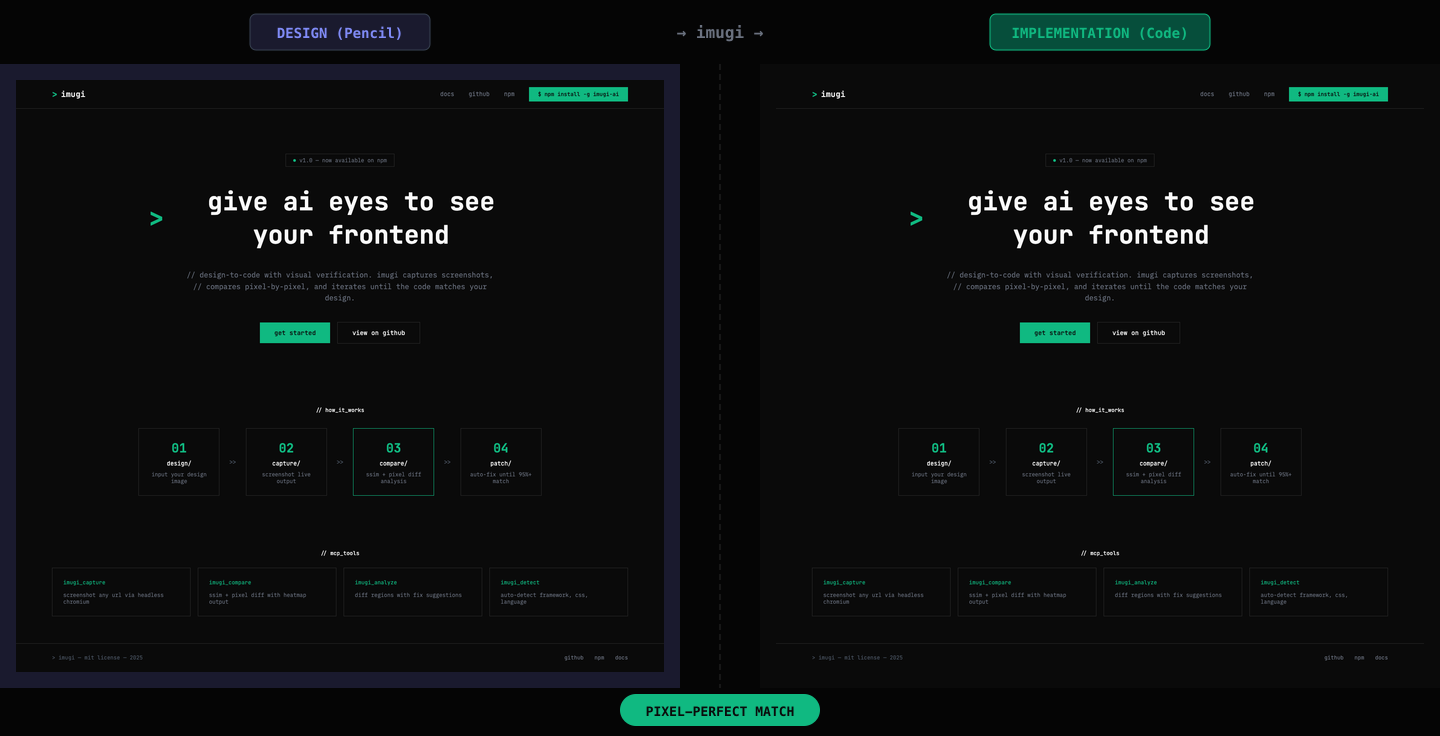
Left: original design. Right: AI-generated code verified by imugi. The AI iterated autonomously until it achieved a pixel-perfect match — nav bar, hero CTA, flow diagram, MCP tools grid, footer, all matching the design down to the pixel.
See the full example at examples/hero-section/.
| Example | Description |
|---|---|
hero-section/ |
Terminal-inspired landing hero with flow diagram |
login-page/ |
Split-panel login with social auth buttons |
pricing-page/ |
3-tier pricing cards (Starter / Pro / Enterprise) |
dashboard/ |
Analytics dashboard with sidebar, stats, and chart |
- Visual Comparison Engine — SSIM + pixel diff scoring with red heatmap showing exact diff locations
- Region Crop Pairs — Side-by-side crop images of each diff region (design vs your code) so AI can visually compare specific areas
- DOM Style Extraction — Extracts computed CSS from your running page (font-size, color, padding, etc.) and maps them to diff regions — AI knows exactly what CSS values to change
- Figma Spec Diff — When
FIGMA_TOKENis set, fetches exact design specs from Figma API and diffs them against your DOM:fontSize: design=42px → your code=48px. No guessing from pixels - Boulder Loop — Automated iterative improvement: capture → compare → patch → repeat until 95%+ match
- MCP Server — Drop-in for Claude Code / Cursor / any MCP-compatible AI tool. No API key needed
- Figma Integration — Export Figma frames directly via URL (
imugi figma <URL>), no manual export - Project Auto-Detection — Detects React/Vue/Svelte/Next.js, Tailwind/CSS Modules/styled-components, TypeScript/JavaScript
- Smart Patching — Full rewrite for low scores (< 0.7), surgical CSS fixes for high scores (>= 0.7)
- Interactive Agent — Terminal UI with real-time iteration progress (powered by Ink)
- CI/CD Ready — GitHub Action for visual regression testing in your pipeline
imugi mcpWorks with Claude Code, Cursor, and any MCP-compatible tool. The AI calls imugi tools to verify and fix its own frontend output.
No API key needed for MCP mode. imugi provides the eyes (capture, compare, heatmap). Your AI editor provides the brain (code generation, patching). You provide nothing extra — zero additional cost.
export ANTHROPIC_API_KEY=sk-ant-...
imugi
Then describe what you want:
> implement this design ./login-design.png
imugi generate ./design.png --output src/app/page.tsx# Compare against a local screenshot file
imugi compare ./design.png --screenshot ./current.png
# Compare against a running dev server URL
imugi compare ./design.png --screenshot http://localhost:3000# Export a Figma frame as PNG
imugi figma "https://www.figma.com/design/FILE_KEY/name?node-id=42-1234"
# Export at 3x scale with custom output path
imugi figma "https://www.figma.com/design/FILE_KEY/name?node-id=42-1234" -s 3 -o design.png
# Export and immediately compare against dev server
imugi figma "https://www.figma.com/design/FILE_KEY/name?node-id=42-1234" --compareRequires a Figma personal access token via FIGMA_TOKEN environment variable or figma.token in config.
| Tool | Description |
|---|---|
imugi_iterate |
The main loop tool. Captures screenshot → compares against design → analyzes diffs → returns score + heatmap + region crop pairs + DOM computed styles + Figma spec diff (if FIGMA_TOKEN set). Returns ACTION_REQUIRED or DONE. Call repeatedly after each code fix. |
imugi_capture |
Screenshot a URL via headless Chromium |
imugi_compare |
Compare design vs screenshot — returns SSIM score, pixel diff, heatmap, and region crop pairs |
imugi_analyze |
Analyze visual differences with actionable fix suggestions |
imugi_figma_export |
Export a Figma frame as PNG via URL or file key + node ID |
imugi_detect |
Detect project tech stack (framework, CSS, language) |
imugi_serve |
Start a dev server for the target project |
The composite score combines multiple signals:
| Signal | What it measures |
|---|---|
| SSIM | Structural similarity — luminance, contrast, structure |
| Pixel diff | Raw pixel-level comparison via pixelmatch |
| Claude Vision | AI-powered visual assessment (CLI agent mode, activated for scores < 0.98) |
Beyond the score, imugi_iterate returns three layers of actionable feedback:
| Layer | What it provides | Requires |
|---|---|---|
| Heatmap + crop pairs | Red overlay showing diff locations + zoomed-in design vs code crops for each region | Nothing (free) |
| DOM computed styles | Actual CSS values (font-size, color, padding...) of elements in each diff region | Nothing (free) |
| Figma spec diff | Exact design-vs-code CSS comparison: fontSize: design=42px → code=48px |
FIGMA_TOKEN |
Strategy selection based on score:
| Score | Strategy | Description |
|---|---|---|
| < 0.7 | Full regeneration | Rewrite the code from scratch |
| >= 0.7 | Surgical patch | Targeted fixes only |
Create imugi.config.json in your project root:
{
  "comparison": {
    "threshold": 0.95,
    "maxIterations": 10
  },
  "rendering": {
    "port": 3000,
    "viewport": { "width": 1440, "height": 900 }
  }
}| Variable | Description |
|---|---|
ANTHROPIC_API_KEY |
Anthropic API key |
IMUGI_API_KEY |
Alternative API key |
IMUGI_THRESHOLD |
Similarity threshold (0.8–0.99) |
IMUGI_MAX_ITERATIONS |
Max iterations (1–50) |
IMUGI_PORT |
Dev server port |
FIGMA_TOKEN |
Figma personal access token — enables Figma export, and exact CSS spec diff in imugi_iterate (design values vs your code) |
src/
├── cli.ts              # CLI entry point (Commander.js)
├── mcp/server.ts       # MCP server (stdio transport)
├── agent/
│   ├── auth.ts         # OAuth PKCE + API key auth
│   ├── loop.ts         # Boulder Loop — iterative improvement
│   ├── session.ts      # State management
│   └── ui.tsx          # Terminal UI (Ink/React)
├── core/
│   ├── comparator.ts   # SSIM + pixelmatch + heatmap
│   ├── analyzer.ts     # Diff classification + strategy
│   ├── renderer.ts     # Playwright screenshot engine
│   ├── patcher.ts      # Code generation + patching
│   ├── context.ts      # Project tech stack detection
│   └── figma.ts        # Figma URL parsing + API export + design spec extraction
├── llm/
│   ├── client.ts       # Anthropic SDK wrapper
│   └── prompts.ts      # Prompt engineering
├── config/
│   ├── schema.ts       # Zod validation
│   ├── loader.ts       # Config loading (file + env + CLI)
│   └── defaults.ts     # Default configuration
└── types.ts            # Shared type definitions
How does imugi compare to other design-to-code tools?
| Feature | imugi | Anima | Locofy | Screenshot-to-Code | Vercel v0 |
|---|---|---|---|---|---|
| Visual verification | SSIM + pixel diff + heatmap + crop pairs + DOM styles | None | None | None | None |
| Design spec diff | Figma API → exact CSS comparison (design=42px vs code=48px) | None | None | None | None |
| Automated iteration | Boulder Loop (capture → compare → patch → repeat) | Single pass | Single pass | Single pass | Single pass |
| MCP server | Native MCP for Claude Code / Cursor | No | No | No | No |
| Open source | MIT | No | No | Yes | No |
| Additional API key | Not needed in MCP mode | Required | Required | Required | Required |
| Figma integration | Direct URL export | Plugin | Plugin | No | No |
| Framework detection | Auto (React, Vue, Svelte, Next.js) | Manual | Manual | Limited | Auto |
| Pricing | Free | Paid | Paid | Free (self-host) | Freemium |
imugi is the only tool that measures design-to-code fidelity with an objective score and automatically iterates until the code matches the design. Other tools generate code in a single pass with no verification step.
If imugi helped you skip the manual CSS grind, consider giving it a star.
git clone https://github.com/M00N7682/imugi.git
cd imugi
npm install
npm run build
npm test
See CONTRIBUTING.md for guidelines.